Wednesday, March 18, 2026

DEC Announces Proposed Changes to Hunting Regulations to Increase Harvest of Antlerless Deer Click to teach Gmail this conversation is important


Logo

Proposed Changes Include Modifications to DEC’s Deer Management Permit Process

The New York State Department of Environmental Conservation (DEC) today announced several proposed regulation changes to increase harvest of antlerless deer by hunters. These proposed actions will improve DEC’s ability to manage deer populations to help ensure a healthy herd while also preventing potential increases in deer-vehicle collisions, reduced forest regeneration, and other negative impacts of deer overabundance.


“Deer populations are growing throughout much of New York State,” DEC Commissioner Lefton said. “Increased harvest of antlerless deer by hunters is necessary to keep deer populations healthy, in balance with available habitat, and at levels that are acceptable to all members of the public.”


During recent hunting seasons, less than 15% of licensed hunters harvested one antlerless (primarily female) deer and only about 3% of hunters harvested two or more antlerless deer. The proposed regulations are intended to encourage and incentivize hunters to harvest more antlerless deer to help better manage deer populations.


Over the past few years, DEC evaluated a variety of regulatory and non-regulatory options to increase harvest of antlerless deer. The process incorporated results from a series of focus groups, a statewide survey of deer hunters, and input from professional deer biologists and managers across the Northeast. Based on that evaluation, DEC proposes several actions. 


Modifying the Deer Management Permit (DMP) issuance process to increase DMP availability

Some Wildlife Management Units (WMUs) have no DMP quota, resulting in unlimited DMP availability. DEC’s proposed regulations would create a second pathway for DMP issuance in units without a quota, allowing hunters to simultaneously apply for two DMPs in WMUs without a quota and two DMPs in WMUs with a quota through the typical lottery process. This would enable hunters to potentially obtain up to four DMPs when buying a license and all hunters who apply for DMPs in units without a quota would receive them.


Additionally, hunters who harvest and report antlerless deer using DMPs in any of the WMUs without a quota would automatically receive bonus DMPs, allowing them to continue harvesting antlerless deer.


Currently, Wildlife Management Units (WMUs) 1C, 3S, 4J, and 8C have no DMP quota. The proposed regulation would enable DEC to add and remove WMUs to the list of units without a DMP quota as population management needs change. For 2026, DEC would add 19 WMUs (3M, 3P, 3R, 6P, 7F, 7H, 7J, 7R, 8A, 8F, 8G, 8H, 8J, 8N, 8R, 8S, 9A, 9F, and 9G) to the list of those with no DMP quota.

 
Allow an unlimited number of DMPs to be transferred between hunters

Under current State regulations, hunters can only have two DMPs transferred to them from other hunters. The proposed regulations would allow hunters to have an unlimited number of DMPs transferred to them from other hunters.


Expand the nine-day season for antlerless deer in mid-September

Currently, WMUs 1C, 3S, 3M, 3R, 4J, 8A, 8C, 8F, 8G, 8J, 8N, 9A, and 9F have a nine-day season for antlerless deer in mid-September. The proposed regulations would add 10 WMUs (3P, 6P, 7F, 7H, 7J, 7R, 8H, 8R, 8S, and 9G) to the list of those enrolled in this September season.


Establish an “Earn-a-2nd-Buck" System

Currently, deer hunters can harvest two antlered deer per year – one using their Bow/Muzzleloader Either-Sex Tag and a second using their Regular Season Deer Tag. The proposed regulations would require hunters to harvest and report an antlerless deer before receiving a tag to harvest a second antlered deer. To accommodate this, DEC is proposing to reclassify the current Regular Season Deer Tag as an “Antlered Deer Tag” that could be used during all deer seasons with appropriate license privileges. All hunters would receive this first Antlered Deer Tag upon hunting license purchase.


In addition, as part of a “earn-a-2nd-buck” system, DEC would reclassify the Bow/Muzzleloader Either-Sex Deer Tag as a Bow/Muzzleloader Antlerless Deer Tag. Hunters who purchase the bowhunting and muzzleloader privileges would receive a Bow/Muzzleloader Antlerless Deer Tag for each privilege.


Hunters who harvest and report an antlerless deer on any eligible antlerless deer tag (i.e., Bow/Muzzleloader Antlerless Deer Tag, DMP, or Deer Management Assistance Program Tag) receive a second Antlered Deer Tag which could be used during all deer seasons with appropriate license privileges.


Additional Proposal

A minor change to clarify how mechanical broadheads with moving blades may be deemed non-barbed to comply with the statutory prohibition on use of barbed broadheads for big game hunting. Broadheads with blades that appear barbed, but freely swing forward to a non-barbed position upon withdrawal of the arrow, are not considered barbed. This regulation would clarify that “freely swing” infers no external force beyond gravity.


DEC strives to manage deer populations at levels that are in balance with available habitat and in alignment with public desires by encouraging and empowering hunters to harvest antlerless deer, the primary component of the deer population that drives population growth. DEC assesses public desires for deer population size and deer impacts to forests to determine deer population objectives for each area of the state. Refer to DEC’s Management Plan for White-Tailed Deer in New York State for more information.


Details of the proposed regulations are available at https://dec.ny.gov/regulatory/regulations/proposed-emergency-recently-adopted-regulations. Additional answers to commonly asked questions are available on DEC’s website.


DEC is accepting comments on the proposed regulations through May 17. Comments can be submitted to wildliferegs@dec.ny.gov (subject: “Antlerless Deer Hunting”) or to: NYSDEC, Attn: Jeremy Hurst, 625 Broadway, Albany, NY 12233-4754.


MAYOR MAMDANI UNVEILS NEW TOOLS AND FINANCING TO HELP HOMEOWNERS ADD ANCILLARY DWELLING UNITS


“ADU for You” guide and nearly a dozen pre-approved plans will help homeowners add backyard cottages and other small secondary homes to their property  


City to reopen applications for “Plus One ADU” program that provides financial assistance to homeowners   

ADU Grid

Renderings of pre-approved ADU plans are available HERE. 

Today, Mayor Zohran Kwame Mamdani unveiled a new set of tools to make it easier for homeowners to stay in their communities and bring in extra income by adding an ancillary dwelling unit (ADU) to their property. The city’s new ADU for You website features an ADU Guidebook, a growing Pre-Approved Plan Library, and site feasibility analysis and cost estimating tools to help homeowners navigate bureaucratic and financing details when adding an ADU such as a backyard cottage or “in-law unit.”   


The City will also newly reopen applications for the Plus One ADU program, which offers financial and technical assistance to qualified homeowners to add an ADU. The Plus One ADU program, established with City funding and grants provided by the New York State Homes and Community Renewal, and operated in partnership Restored Homes HDFC, provides homeowners with up to $395,000 in financial support and technical assistance to add an ADU. The program saw overwhelming interest from New Yorkers when it first launched, receiving over 1,300 submissions within two weeks, but has been closed to new applicants since February 2024.  


“One of the solutions to the housing crisis can be found in our backyards, our attics, or our basements – in an Ancillary Dwelling Unit. That's why our administration is making it easier and more affordable to build an ADU through a library of pre-approved plans and new financing options,” said Mayor Mamdani. “By making it easier for New Yorkers to turn their homes into an extra place for a loved one or a little more income, we're allowing our city to grow while keeping the character of the neighborhoods we love.”  


“In the midst of a dire housing crisis, ADUs are an important tool for homeowners to add space, bring in extra income, and stay in their communities - but creating an ADU can feel out of reach for too many New Yorkers. These new tools will help ensure that any New Yorker who wants to add an ADU is able to do,” said Leila Bozorg, Deputy Mayor for Housing and Planning. “Whether you are interested in adding a new backyard cottage or converting an underused garage or attic into housing, we have resources to help guide you through the process.”  


“Ancillary dwelling units have the potential of unlock thousands of safe, quality homes for New Yorkers in low density neighborhoods across the city,” said Buildings Commissioner Ahmed Tigani. “However, these homes will not get built if the permitting process places too many barriers in the way. Today's announcement includes multiple tools that will help remove these barriers, including the new Pre-Approved Plan Library which gives New Yorkers a menu of potential design options that have already undergone an initial review by DOB for code-compliance leading to faster approvals.”  


“By making it easier to navigate rules and offering pre-approved designs, this new homeowner toolkit will help New Yorkers turn the idea of an accessory dwelling unit into a reality,” said Sideya Sherman, Director of the Department of City Planning. “Building on City of Yes for Housing Opportunity, this is another smart step to unlock housing, allow working families to earn additional income, and help seniors afford to age in place.”  


“New York City needs more housing. Some of it is going to come from backyards and basements — and that is not a small thing. ADU for You makes it possible for homeowners who want to be part of the solution to actually do it, giving New Yorkers the plans, the financing, and a clear path forward,” said Dina Levy, Housing Preservation and Development (HPD) Commissioner. 


Thanks to City of Yes for Housing Opportunity and subsequent regulatory changes, one- and two-family homeowners in much of the city can add an ADU to their properties – a change that will help add housing options in low-density areas while maintaining the existing character.   


In addition to helping homeowners understand the regulations and access financing to build an ADU, the Mamdani administration is also launching a simplified permitting process for pre-approved ADU plans. This pre-approved plan library is launching with eleven ADU designs that have already been reviewed and approved by the Department of Buildings (DOB). The city will connect homeowners who select an ADU option from this library with the registered design professional who created the design in order to obtain site-specific approval. DOB will review and add additional pre-approved plans as they are submitted by design professionals.  

Illegal Alien MS-13 Gang Member Sentenced to 55 Years in Prison for Multiple Murders in Queens, NY


DHS has arrested more than 7,800 criminal illegal alien gang members from American communities since President Trump took office 

The Department of Homeland Security (DHS) released the following statement regarding Ramiro Antonio “Cara de Malo” Gutierrez Garcia, a criminal illegal alien from El Salvador and confirmed Mara Salvatrucha (MS-13) gang member, who received a 55-year sentence for his participation in two murders in Queens, New York.

According to local reporting about the horrific crimes, on November 4, 2018, Gutierrez Garcia and his fellow MS-13 gang members shot and killed Victor Alvarenga near his home in Flushing, Queens. Gutierrez Garcia allegedly served as the getaway driver and helped plan the murder, which was ordered by MS-13 leadership and coordinated by multiple gang members.

Then, on February 3, 2019, Ramiro Gutierrez and two other MS-13 gang members stalked 20-year-old Abel Mosso – who they believed to be a rival gang member – onto the 7 train at Main Street station in Flushing, Queens. Inside the subway car, the gang members violently assaulted Mosso, then dragged him out onto the crowded platform at the 90th Street station in Jackson Heights. As commuters watched in horror, the attackers brandished a firearm, which Mosso managed to wrestle away. One of the assailants shouted in Spanish, “Nobody get involved, we’re MS-13, we’re going to kill him.” Gutierrez Garcia then seized the gun from Mosso and, in a brazen act of brutality, shot him multiple times in the head, executing him in broad daylight before fleeing the scene.

Homeland Security Investigations (HSI), working in close coordination with federal and local law enforcement partners, played a pivotal role in the investigation, arrest, and successful prosecution of Gutierrez Garcia, who was sentenced to 55 years in federal prison.

MS13 1

“This MS-13 gang member participated in two brutal murders while illegally in our country. This monster is now facing 55 years in prison for these barbaric murders,” said Acting Assistant Secretary Lauren Bis. “MS-13 is one of the most barbaric criminal gangs in the world. They rape, maim, and murder for sport. President Trump is dismantling transnational criminal gangs. DHS has arrested more than 7,800 criminal illegal alien gang members from American communities since President Trump took office.”

Gutierrez Garcia illegally entered the U.S. at an unknown place and time.

DHS law enforcement is protecting American communities every day from another senseless tragedy like this taking place in another town, to another family. Victims of illegal alien crime may receive support from the Victims of Immigration Crime Engagement (VOICE) Office by contacting 1-855-488-6423.

Justice Department Files Case to Revoke U.S. Citizenship of Mastermind Behind Multimillion-Dollar Tax Fraud Scheme


Today, the U.S. Department of Justice announced that it has filed and served a civil denaturalization complaint in the U.S. District Court in Baltimore, Maryland, against Emmanuel Oluwatosin Kazeem, a native of Nigeria who organized a vast conspiracy to steal identities and file fraudulent tax returns. In 2017, he was convicted of 19 counts of mail and wire fraud, aggravated identity theft and conspiracy to commit mail and wire fraud and sentenced to 15 years in prison. But in 2024, then-President Biden commuted his sentence after only six years.

“The Trump Administration will not permit wrongdoers to retain the U.S. citizenship that they were never entitled to in the first place,” said Assistant Attorney General Brett A. Shumate of the Justice Department’s Civil Division. “U.S. Citizenship is a privilege, and we will continue to ask courts to revoke a status that was obtained through fraud and deceit.”

The newly filed denaturalization complaint alleges that Kazeem’s fraud scheme, which he committed in the years before and after his naturalization, along with his concealment of his crimes, precluded him from obtaining his naturalization lawfully. The complaint also alleges that Kazeem had, prior to his fraud scheme, engaged in a sham marriage to obtain permanent resident status and then married a second woman, further disqualifying him from naturalization.

According to court documents and evidence presented at Kazeem’s criminal trial, in May 2013, a victim in Medford, Oregon, notified the IRS that false federal and Oregon state tax returns were filed electronically using her and her husband’s personal identifying information (PII) including social security numbers and dates of birth.

An IRS investigation led to search warrants of residences in Illinois, Maryland, and Georgia and to numerous email and instant messenger accounts used by Kazeem and other co-conspirators. At a Chicago residence, agents seized approximately 150 prepaid debit cards and $50,000 in money orders. In Maryland and Georgia, agents seized more than 50 electronic devices, 40 money orders in amounts exceeding $29,000, $14,000 in cash and numerous prepaid debit cards containing over $12,000 in fraudulent tax refunds. The search warrants helped agents identify Kazeem as the leader and mastermind of the scheme.

The scheme resulted in the conspirators possessing stolen PII of more than 259,000 victims. Kazeem purchased more than 91,000 identities from a Vietnamese hacker that originated from an Oregon company’s private database. The company provided pre-employment and volunteer background checks for thousands of clients. Kazeem divided the identities into batches and shared them with other co-conspirators. They were in turn used to file fraudulent tax returns between 2012 and 2015.

In carrying out the scheme, Kazeem trained and directed his co-conspirators including his younger brother, Michael Oluwasegun Kazeem, to use stolen PII to obtain thousands of electronic filing PINs to bypass IRS authentication procedures. They acquired over 19,500 E-File PINS during the course of the conspiracy. Kazeem also used taxpayers’ PII to gain unauthorized access into many taxpayers’ IRS transcripts, which contain sensitive personal financial information. Conspirators also used pre-paid debit cards with the victims’ stolen identities to receive direct electronic tax refund deposits from the IRS.

In total, Kazeem was linked to 10,139 fraudulent federal tax returns attempting to get over $91 million dollars in refunds and successfully receiving over $11.6 million dollars. Refunds were withdrawn from the debit cards and at least 2,000 wire transfers totaling over $2.1 million dollars were sent to Nigeria. Over 700 of those wire transfers, totaling more than $690,000, were directly linked to Kazeem.

Kazeem used the conspiracy windfall to place a nearly $200,000 down payment on a newly constructed house and to purchase a $175,000 townhouse, both in Maryland. His average monthly credit card payment during 2012 to 2015 was over $8,300. Kazeem also attempted to use his ill-gotten funds to develop a $6 million dollar, 4-star hotel in Lagos, Nigeria.

In May 2015, Kazeem transferred the townhouse to his sister in Nigeria for $10 and included her on the deed to his Maryland residence, also for $10. He was arrested one day later.

On June 20, 2018, Kazeem was sentenced to 15 years in prison and ordered to pay more than $12 million in restitution. However, on Dec. 12, 2024, then-President Joe Biden commuted Kazeem’s sentence, along with nearly 1,500 others who had been serving under house arrest following their release from prison due to conditions associated with the COVID-19 pandemic.

Kazeem’s criminal conviction resulted from a joint investigation by IRS-Criminal Investigation, the U.S. Department of Health and Human Services, Office of Inspector General and the FBI. Investigative support was provided by the Treasury Inspector General for Tax Administration; the U.S. Postal Inspection Service; the U.S. Department of State; the U.S. Department of Homeland Security, Homeland Security Investigations (DHS HSI) and U.S. Citizenship and Immigration Services.

Kazeem’s criminal case was prosecuted by Assistant U.S. Attorneys Byron Chatfield and Gavin Bruce for the District of Oregon. Kazeem’s denaturalization case was investigated by DHS HSI and will be litigated by the Affirmative Litigation Unit of the Civil Division’s Office of Immigration Litigation.

Poughkeepsie Man Sentenced To 15 Years In Prison For Selling Guns, Fentanyl, And Crack Cocaine


United States Attorney for the Southern District of New York, Jay Clayton, announced that Joseph Crocco was sentenced to a total of 15 years in prison for dealing guns, fentanyl, and crack in Poughkeepsie, New York, while on federal supervised release.  In June 2025, the defendant was convicted following a four-day trial before U.S. District Judge Cathy Seibel, who imposed yesterday’s sentence. 

“Joseph Crocco sold deadly drugs and loaded guns to New Yorkers, understanding that they would be used to violent and poisonous ends,” said U.S. Attorney Jay Clayton.  “New York families want repeat offenders, particularly those who deal in fentanyl and guns, off the streets. This sentence delivers that.” 

According to the allegations in the Indictment, the evidence at trial, court filings, and statements made in court:

Between June and July 2024, CROCCO sold narcotics and firearms from his residence in Poughkeepsie, New York, to an undercover New York State Police officer.  During a series of controlled purchases made at CROCCO’s home, CROCCO sold fentanyl, crack, cocaine, and cutting agents such as xylazine, also known as “tranq.”  CROCCO also sold two loaded semi-automatic handguns and boxes of ammunition to the undercover officer as part of one of the drug deals.

in pr

Firearms, Ammunition, and a Portion of the Drugs Sold by CROCCO

On July 24, 2024, law enforcement executed a search warrant at CROCCO’s residence and recovered additional narcotics, drug paraphernalia, and ammunition.  CROCCO had previously been convicted of multiple felony offenses that made it illegal for him to possess a firearm, including voluntary manslaughter.  At the time he committed these offenses, CROCCO was on supervised release following a prior federal bank robbery conviction.

In addition to the prison term, CROCCO, 49, of Poughkeepsie, New York, was sentenced to three years of supervised release and ordered to forfeit all of the firearms and ammunition involved in the offense.

Mr. Clayton praised the outstanding investigative work of the Bureau of Alcohol, Tobacco, Firearms and Explosives, the New York State Police, and the City of Poughkeepsie Police Department.

Attorney General James Calls on Congress to Pass Legislation Requiring Tariff Refunds


New York Attorney General Letitia James today co-led a coalition of 17 other attorneys general in urging Congress to pass legislation that would require the government to provide swift refunds for extra costs paid by businesses and consumers due to President Trump’s illegal tariffs. On February 20, the Supreme Court ruled in favor of Attorney General James and a coalition of 11 other states and struck down tariffs the Trump administration imposed under the International Emergency Economic Powers Act (IEEPA). Businesses and individuals nationwide have been charged approximately $166 billion in unlawful IEEPA tariffs, which resulted in higher prices that disproportionately strained low-income consumers’ finances. Attorney General James and the coalition are calling on Congress to pass new legislation that would require the Trump administration to reimburse importers for these illegal tariff charges with interest and encourage businesses that passed along direct tariff costs to consumers to reimburse their customers who ultimately bore the financial burden.

“New Yorkers were charged illegal taxes for months because of this administration’s tariff policy. Now they deserve a refund,” said Attorney General James. “These tariffs hurt businesses across our state and raised the cost of groceries, clothes, and other essentials. If this administration won’t do the right thing and give New Yorkers their money back, Congress must step in to get justice for consumers and businesses.”

In April 2025, President Trump imposed sweeping tariffs on countries across the globe by claiming he had the authority to do so under IEEPA. Shortly after, Attorney General James and a coalition of 11 other attorneys general sued the administration, arguing that IEEPA does not give the president the power to impose tariffs. On February 20, 2026, Attorney General James and the coalition won their lawsuit at the Supreme Court, which struck down the IEEPA tariffs. While the Supreme Court did not make a decision regarding tariff reimbursements, the administration had repeatedly committed in court filings that they would need to refund tariff costs with interest if the IEEPA tariffs were ruled unlawful.

The tariffs imposed significant costs on New York businesses and consumers throughout the state who have been charged an estimated $13.5 billion as a result of the president’s tariffs. In January 2026 alone, New York consumers paid over a billion dollars in tariff-driven price increases.

In a letter to House and Senate leadership, Attorney General James and the coalition are urging Congress to pass legislation requiring the administration to issue automatic tariff refunds as soon as possible. While the administration has indicated that importers would need to apply or sue for refunds, U.S. Customs and Border Protection (CBP) has a database of every illegal IEEPA tariff paid by American direct importers. The CBP has stated that refunds will only be available via a new direct deposit platform that only six percent of importers are currently registered for. The administration has also suggested that importers may need to navigate multiple refund processes depending on their shipment’s status. A refund process controlled by the administration would likely face delays and disadvantage small businesses and individuals that do not have the resources to navigate a complicated application process or sue for refunds. Attorney General James and the coalition are pushing for new legislation that could create an equitable, uniform, and fast process for all affected importers to be reimbursed for their tariff costs.

In addition, Attorney General James and the coalition urge Congress to hold accountable the businesses that directly passed on tariff costs to consumers and other businesses. Importers that raised prices due to tariff costs should pass the benefit of the refunds they receive to those who ultimately bore the financial burden of the administration’s illegal tariffs. Congress should also consider other ways to address the economic burden that the most financially vulnerable had to bear because of the administration’s illegal policy. As the attorneys general assert, prices of cheaper products rose faster than prices of more expensive goods as a result of the tariffs, disproportionately impacting low-income consumers.

Joining Attorney General James in sending this letter are the attorneys general of Arizona, California, Colorado, Connecticut, Delaware, Maine, Maryland, Massachusetts, Michigan, Nevada, New Jersey, New Mexico, North Carolina, Oregon, Vermont, Virginia, and Washington.   

Bruckner Heights Finishes Construction at 2070 Chatteron Avenue and 1017 Olmstead Avenue in Unionport, The Bronx


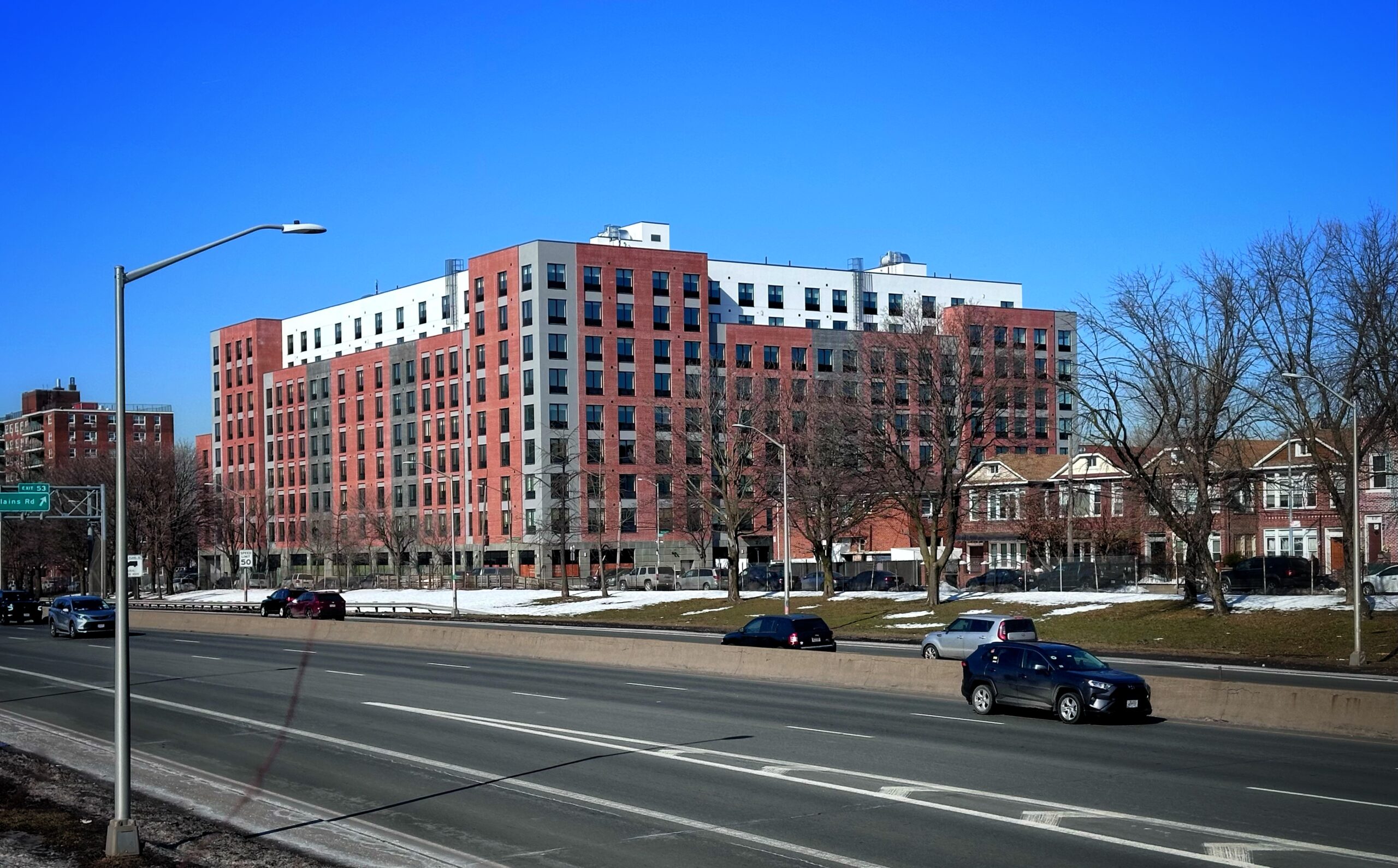
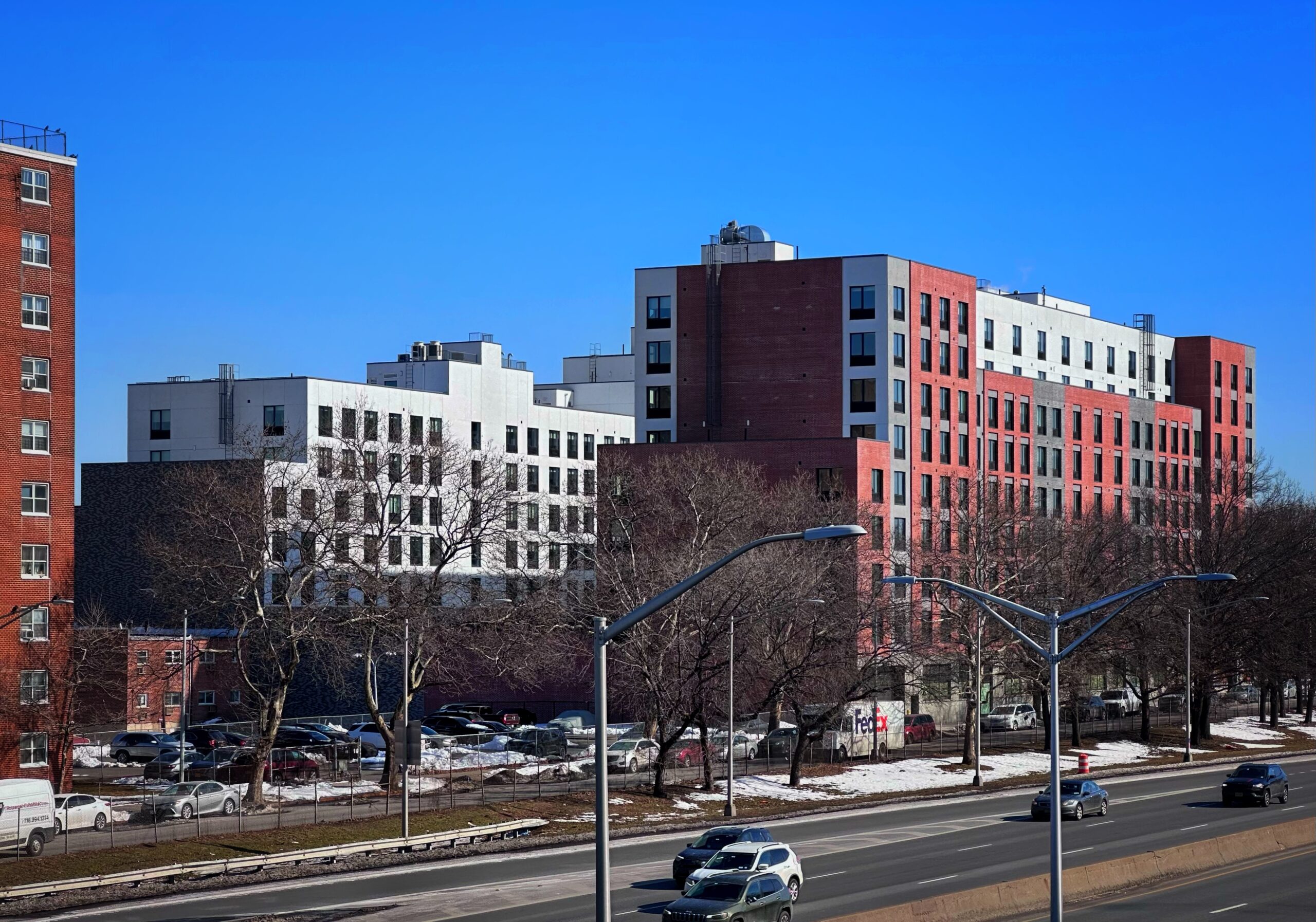
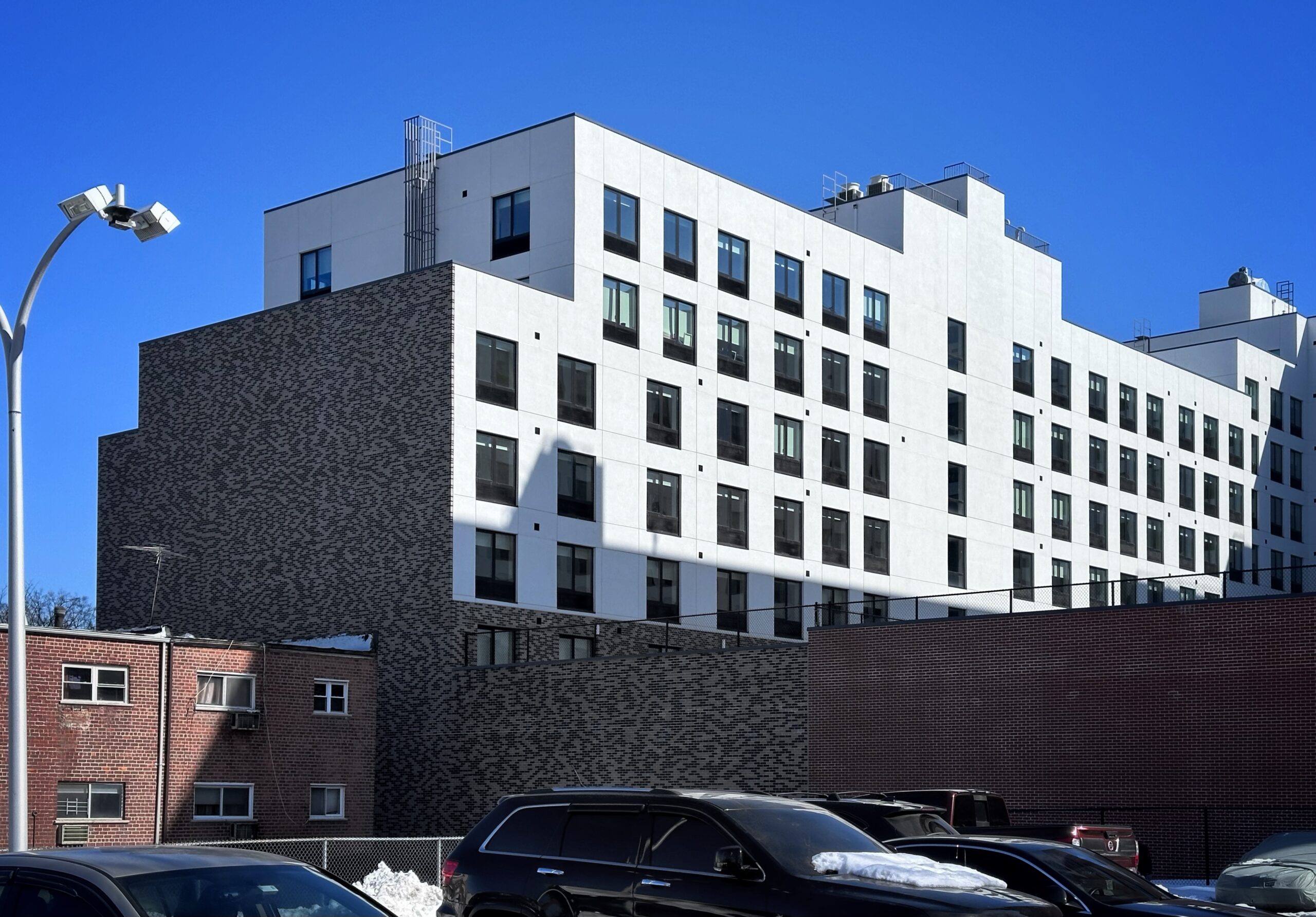
Construction is finished on Bruckner Heights, a two-building residential complex consisting of the seven-story 2070 Chatteron Avenue and nine-story 1017 Olmstead Avenue in Unionport, The Bronx. Designed by Aufgang Architects and developed by Azimuth Development Group, the conjoined structures yield a combined 330 rental units, with 274 units designated for affordable housing. The project also includes ground-floor commercial space. The property is bounded by Chatterton Avenue to the north, Bruckner Boulevard to the south, and Olmstead Avenue to the east.

The following photos show the completed exterior of 1017 Olmstead Avenue from Bruckner Boulevard and across the Bruckner Expressway. The façade is composed of red and gray brick framing a uniform grid of PTAC windows with black metal frames. The southeast corner features a light gray cementitious finish, the top two floors are clad in white paneling, and gray blocks surround the commercial windows on the ground floor along Bruckner Boulevard and Olmstead Avenue. The entrance is situated on Olmstead Avenue underneath a glass and metal canopy.

Bruckner Heights. Photo by Michael Young.

Bruckner Heights. Photo by Michael Young.

Bruckner Heights. Photo by Michael Young.

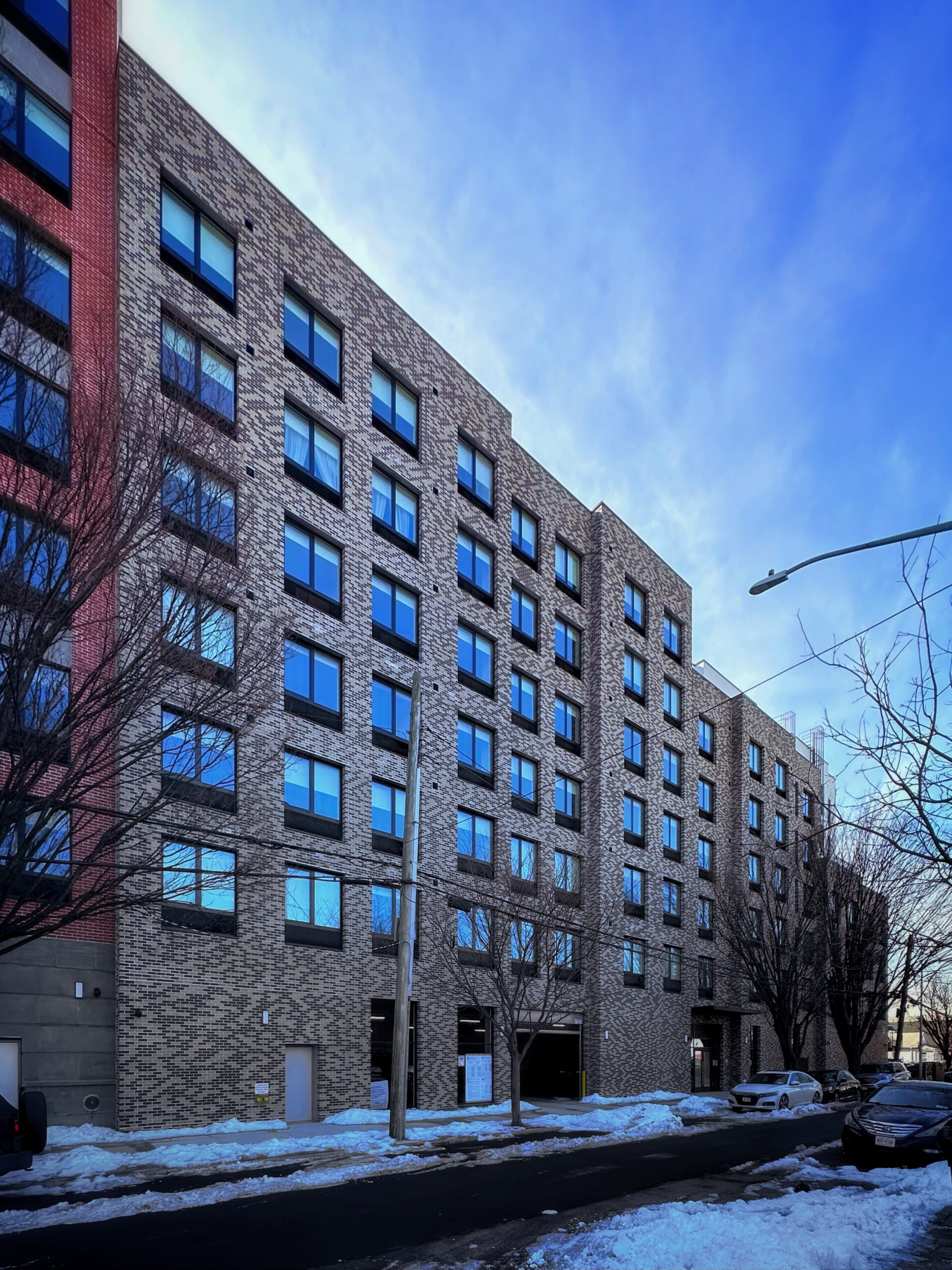
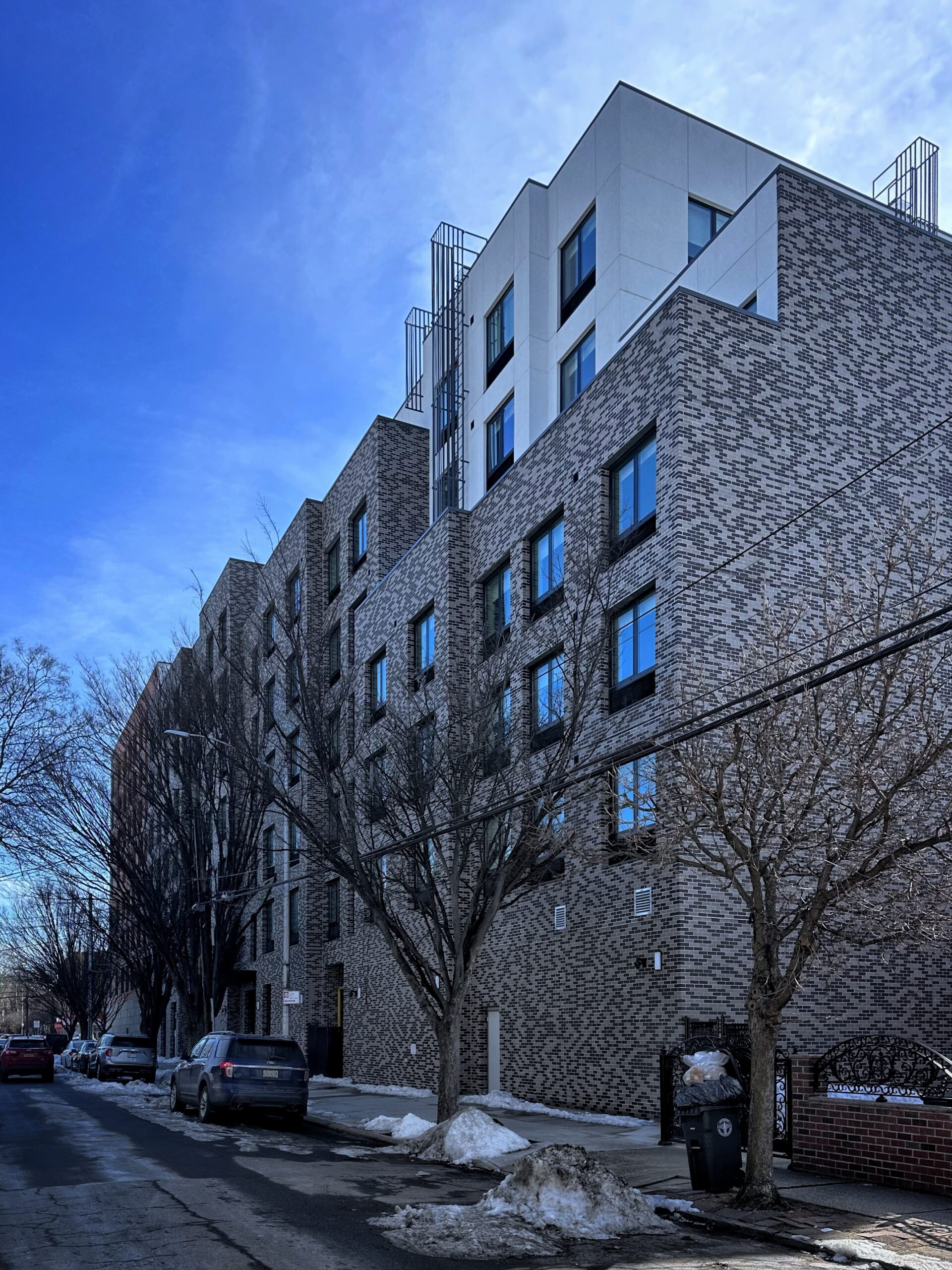
The below photos show 2070 Chatteron Avenue, which features a gray brick façade speckled with black bricks on front northern elevation. The entrance is located next to the enclosed parking garage entrance.

Bruckner Heights. Photo by Michael Young.

Bruckner Heights. Photo by Michael Young.

Portions of the top floors and the interior facing wall are clad in white EIFS.

Bruckner Heights. Photo by Michael Young.

The above rendering is an aerial perspective looking west at 1017 Olmstead Avenue, the taller of the two buildings. Below is a street-level rendering showing the shorter 2070 Chatterton Avenue along the northern end of the block. 

Apartments come in studio to three-bedroom layouts, and the affordable units are available to residents at 30 to 70 percent of the area median income (AMI).

Amenities at Bruckner Heights include indoor and outdoor recreation area, a community room, bicycle storage, shared laundry room, and on-site parking. Rent includes gas for heating and hot water. Tenants are responsible for electricity, including the electric stove.

The nearest subway from the ground-up development is the 6 train at the elevated Parkchester and Castle Hill Avenue stations to the north above Westchester Avenue. Several bus lines are also within close proximity of the property, including the BX5, BX22, Q44-SBS, BxM8, Bx36, and Bx39.

Permits Filed for 257 East 201st Street in Bedford Park, The Bronx


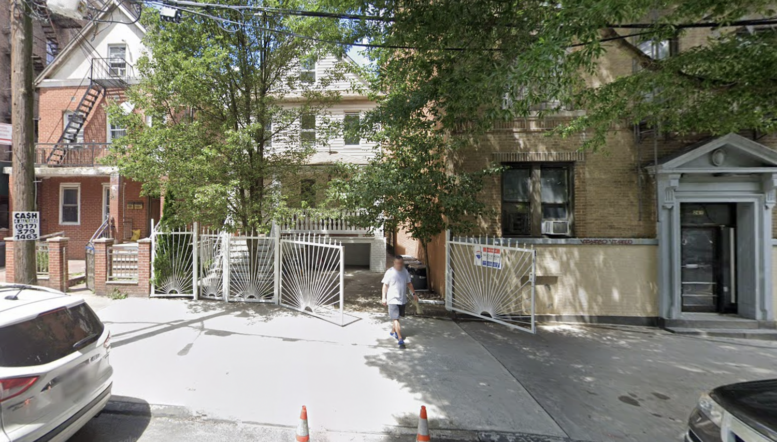
Permits have been filed for an eight-story residential building at 257 East 201st Street in Bedford Park, The Bronx. Located between Briggs Avenue and Valentine Avenue, the interior lot is near the Bedford Park Boulevard subway station, served by the B and D trains. Geraldo Zefi of Geri Z Development LLC is listed as the owner behind the applications.

The proposed 74-foot-tall development will yield 27,696 square feet designated for residential space. The building will have 44 residences, most likely rentals based on the average unit scope of 629 square feet. The concrete-based structure will also have a 32-foot-long rear yard.

Badaly Architects is listed as the architect of record.

Demolition permits were filed this month for the two-family residential building on the site. An estimated completion date has not been announced.