Monday, April 6, 2026

INVESTOR ALERT: Attorney General James Warns New Yorkers of Investment Scams on Meta Platforms


New York Attorney General Letitia James today issued an investor alert to warn New Yorkers about the prevalence of fraudulent investment schemes proliferating across Meta platforms, including on Facebook, Instagram, and WhatsApp. Scammers are increasingly using deceptive advertisements and “deepfake” technology to lure investors into high-stakes scams to defraud them of their savings. These scams include “pump and dump” scams, confidence scams, and fraudulent cryptocurrency schemes that take advantage of victims to extract as much money from them as possible.

Attorney General James is providing tips for New Yorkers to protect themselves from scams and urging every investor to carefully scrutinize social media investment advertisements before investing. Most reputable broker-dealers and investment advisors do not post specific investment advice on social media platforms. Investors should report any suspicious activity to the Office of the Attorney General (OAG).

“Scammers are using social media to exploit the names of trusted financial leaders and celebrities to steal New Yorkers’ hard-earned savings,” said Attorney General James. “From fake investment platforms to deepfake celebrity endorsements to fraudulent cryptocurrencies, these schemes are becoming more sophisticated. I urge everyone to remain vigilant, be skeptical of any social media investment ads and remember: if an investment sounds too good to be true, it is probably a scam. Any suspicious ads or offers should be reported to my office.”

How Pump and Dump Social Media Scams Work
In a pump and dump scheme, victims are lured into investment groups and convinced to invest in cryptocurrencies or low-priced stocks. The scammers advertise, hype, and recommend buying the stocks or cryptocurrencies, increasing their prices, and then sell when the price is high, while the victims lose their money. Pump and dump schemes typically follow a three-step process:

  • The Bait: Scam ads appear on Facebook or Instagram featuring recognizable figures, like Cathie Wood (Ark Invest), Joe Kernen (CNBC), or Kevin O’Leary (Shark Tank), without their permission. Other ads may feature less well-known financial advisors, also without their permission, especially those trusted by members of specific cultural or geographic communities. The ads often promise exclusive “insider” memberships or “guaranteed” high-return investment tips.
     
  • The Shift: Once a user clicks the ad, they are pressured to move the conversation to WhatsApp or other encrypted platforms such as Telegram. This allows scammers to operate away from platform moderators.
     
  • The Hook: Victims are funneled into group chats where they receive so-called “expert” advice and false testimonials. Eventually, victims are coerced into buying stocks or crypto, with the initial fraudulent tips sometimes appearing successful and generating a profit. Victims are convinced to invest large amounts in a stock or cryptocurrency, which then goes up in price and which the scammers sell off at this inflated price, leaving the victims to lose their money once the price plummets.
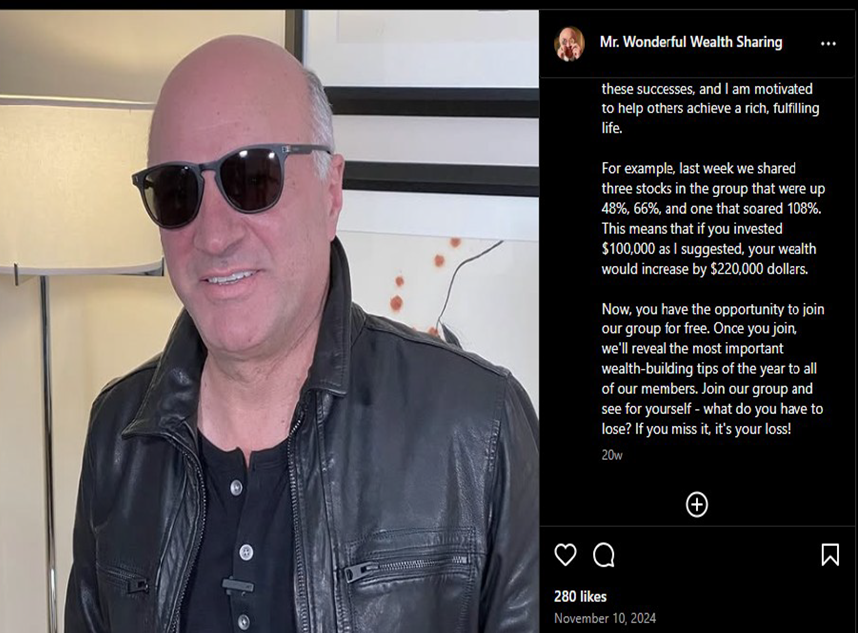
An example of an ad for a potential pump and dump scheme featuring a photo of Kevin O’Leary used without his permission

How Confidence Scams Work
In confidence scams, fraudsters develop trusting relationships with their victims and convince them to “invest” using fake investment platforms that drain the victims’ money. These scams can also follow a three-step process:
  • The Bait: Scammers post ads suggesting that investors can make money using an investment platform or strategy. These ads may also feature well-known figures or institutions. Once the user clicks on an ad, they may be asked to enter their contact information. Other times, they will be taken to a different website that further describes the investment strategy or platform – often resembling a news article – where they are then asked to enter their contact information.
     
  • The Investment: After the user provides their account information, they will be contacted by scammers who develop a relationship of trust and confidence with the victim. The scammers may offer to "teach" the user how to trade on a fake investing platform or even connect the victim with their own personal advisor who will speak with the user on a daily basis. The scammers will then guide their victims to a professional-looking website or app (which is often a clone of a real trading platform). Often victims will be asked to invest a small amount at first and the app will show the investment making significant profits over the course of a few days. To prove it's "real," the scammers may let the victim withdraw some of the initial profit back to their bank account. Believing the platform is legitimate and having developed a close connection with the scammers who are providing the investment advice, victims will over time invest large amounts of money and may even take out loans from friends or family to fund their investments. 
  • The Scam: Once the victims seek to withdraw their profits, they are told they need to pay some kind of fee, such as a commission or tax, to do so. Even if the victims pay, the scammers will find other excuses not to return the money. Once the victim stops paying these fees or making more investments, the scammers will disappear along with the victim’s investment. 

An example of a potential confidence scam ad. Translation: “SEIZE YOUR OPPORTUNITY, Gain KNOWLEDGE and PROFIT with ChatGPT bot. LEARN MORE”

An example of a potential confidence scam ad. Translation: “SEIZE YOUR OPPORTUNITY, Gain KNOWLEDGE and PROFIT with ChatGPT bot. LEARN MORE”

  • Protect Yourself from Social Media Investment Scams
    Investors should be very cautious before responding to any social media investment ads and making any related investments. Remember that social media sites may be hosting billions of scam ads each day, and reputable broker-dealers and investment advisors (especially individuals) typically do not advertise their investment strategies on social media. Attorney General James recommends New Yorkers stay vigilant to avoid falling victim to predatory investment schemes on social media and take the following steps to protect themselves:

1. Identify "Red Flags"
When browsing social media sites like Facebook and Instagram and interacting with supposed investment professionals online, be highly skeptical if you see:

  • Promises of guaranteed returns: No legitimate investment is “risk-free” or offers a guaranteed return.
     
  • High-pressure tactics: Warnings that you will “miss out” or demands to invest immediately.
     
  • Celebrity endorsements: Scammers often use AI-generated images or videos of famous entrepreneurs to lure victims.
     
  • Cryptocurrency demands: Requests to use crypto ATMs or to send crypto to private wallets or platforms should be regarded with suspicion.
     
  • Requests to accept other people’s money: Scammers will sometimes ask victims to accept other people’s funds in their bank accounts and convert them to cryptocurrency. 
     
  • Platform hopping: Requests to move the conversation from Facebook to encrypted apps like WhatsApp or Telegram.

2. Verify Before You Invest
Never take an ad or salesperson’s word at face value. Remember that a salesperson’s job is to be persuasive and paint a rosy picture. Conduct your own independent research:

  • Verify credentials: Use FINRA’s BrokerCheck to confirm if a professional is registered. But be wary, scams may often impersonate people, firms, and their credentials.
     
  • Search for reviews: Search the name of the company or salesperson alongside words like “scam” or “complaint.”
     
  • Check email addresses: Verify that you are communicating with a real email associated with a real advisor’s company. Remember that scammers may register email addresses that are slightly different or may change one letter from a legitimate domain.
     
  • Look for spelling errors: Given that many scams sometimes originate overseas, ads and other communications may have spelling mistakes. 
     
  • Consult with a trusted advisor: Before investing, consult a trusted legal professional or financial advisor who can advise you if the investment is proper.
     
  • Follow warnings from current advisors: If your bank or investment/financial advisor cautions you about your new investment, take time to further investigate the new “investment opportunity” and do not simply dismiss their concerns.
     
  • Trust your instincts and think twice before investing: If an investment seems fishy or too good to be true, it probably is.

3. Beware of "Deepfakes" and AI
Scam ads now use sophisticated technology to mimic real people in videos or livestreams.

  • Spot the fake: If a video seems slightly "off" or the audio doesn’t perfectly match the lip movements, it may be a deepfake.
     
  • Reverse search: If you see a video of a famous figure, search for the original footage online. Fraudsters often repurpose old interviews.
     
  • Beware of financial advice: Famous figures do not usually provide financial advice online or advertise investments in obscure cryptocurrency trading platforms.

4. Protect Your Identity and Network
Your Facebook, Instagram, and WhatsApp profiles are gold mines for scammers looking to build a relationship with you.

  • Lock down your profile: Change your settings to keep your friends list, photos, and posts private. This prevents scammers from seeing who you know.
     
  • Verify friends: If a friend suddenly messages you about a "great investment opportunity," contact them outside of Facebook via phone call or text to ensure their account hasn't been hacked.
     
  • Never share credentials: Do not provide login info, social security numbers, or financial details to anyone you met online.
     
  • Do not provide strangers access to your devices: Do not allow anyone you do not know well to access your computer or mobile phone remotely to help you with your existing investment account or open a new account. Often times, scammers will pose as a representative of the company you have an account with and ask for a password or answers to the security questions and – within seconds – empty everything in your account.

New Yorkers should keep in mind that most fraudulent transactions, especially those involving cryptocurrency, are irreversible. If you choose to invest, always keep a paper trail and archive all communications. After you lose your money, you may hear from a purported asset recovery specialist or attorney who promises to retrieve the money you lost for a fee. Be very wary of these people as some of them may have no interest or qualification to help you and are just taking advantage of your situation to make money – and may even be scammers themselves.

Attorney General James encourages anyone who may have been a victim of these types of scams to report it to OAG online or by calling 1 (800) 771-7755. Any identifying information provided to OAG will be protected according to law and policies on the safeguarding of identifying information.

Smoother, Safer Roads: Following Historic Winter, Governor Hochul Announces Launch of Unprecedented Effort to Fill Potholes and Repave Roads Across New York State

Governor Hochul joins a DOT crew to fix a pothole

215 NYSDOT Crews Will Fill 175,000 Potholes on State Roads Across New York This Month

Paving Work Is Now Underway on State Highways Across New York, Including $58 Million in Paving Work on Long Island and a $5.1 Million Project on Harlem Road in West Seneca

Governor Kathy Hochul today announced an unprecedented state effort to fill potholes and repave roads across New York State, following one of the coldest winters in recent memory. This month, State Department of Transportation (NYSDOT) forces will conduct a statewide push to address potholes on state roads. In April, 215 crews will place more than 8,000 tons of asphalt to fill an anticipated 175,000 potholes statewide. Plans are in place to fill hundreds of thousands more as the weather permits over the months ahead.

“I know where each and every pothole is hiding on the state highway system, and I have bad news for these public nuisances: Your days are numbered,” Governor Hochul said. “We’ve had an unforgiving winter this year in New York, and the frigid cold and heavy snowfall can take a toll on our roads. That’s why we are stepping up with an unprecedented state effort to repave hundreds of miles of roadway and fill hundreds of thousands of potholes in the next few weeks alone. Our outstanding DOT and Thruway crews will not rest until every pothole in this state has been repaired.”


In addition, Governor Hochul highlighted that this week is the official start of paving season in New York, as NYSDOT crews commence the most ambitious year of road improvements in state history. Last October, the Governor announced record state investment to dozens of vital state roadways across New York State during the 2026 construction season. Leveraging the $800 million secured in the FY26 Executive Budget to augment the final two years of its five-year Capital Plan, NYSDOT will invest more than $600 million in more than 180 paving projects across the state to be completed in the upcoming paving season.

These projects, which total almost 2,150 lane miles, are in addition to the paving initiatives already scheduled as part of NYSDOT’s core programs and, taken together, represent the most ambitious annual road resurfacing program conducted in state history, totaling more than 4,000 lane miles of renewed pavement to give New York drivers a smoother, safer ride.


The Governor’s announcement today comes as statewide asphalt plants come online, with paving season beginning in most regions of New York. On Long Island work will begin on a $58.8 million investment to improve its transportation network with new pavement, curb ramps, turning lanes and other features introduced to critical roadways, including the Northern State Parkway, Nassau Expressway, Veterans Memorial Highway, Hempstead Turnpike, Middle Country Road and Sunrise Highway’s service roads.

These Long Island projects include:

  • An $18.5 million project to repave 50 lane miles on the Northern State Parkway in Nassau and Suffolk Counties has begun. Resurfacing the parkway’s eastbound direction will begin at the Wantagh State Parkway interchange (Exit 33) in the Village of Westbury and continue eastward to the New York Avenue overpass near Exit 40 in the Town of Huntington. The westbound lanes were completed last fall. When this section is completed in the summer, it will mark the final phase of a five-year effort to renew the parkway’s riding surface with previous sections being completed in 2020, 2023, and 2024.
  • A $13.8 million project to resurface approximately 36 lane miles of State Route 24 (Hempstead Turnpike/Fulton Avenue) and State Route 102 (Front Street) in and around the Village of Hempstead, which is one of the most densely populated areas of Long Island and is a major economic and transportation hub. Work is planned at the following locations: State Route 24 between Munson Avenue and North Franklin Street; State Route 24 between Hendrickson Avenue and the Meadowbrook State Parkway; and State Route 102 from William Street eastward to State Route 24.
  • An $8.8 million pavement renewal project that’s now getting started that will rehabilitate 27 lane miles of roadway and upgrade approximately 100 sidewalk ramps at the following locations: Nassau Expressway (State Route 878) between Burnside Avenue and the Atlantic Beach Bridge toll booth in the Town of Hempstead, Nassau County; and Veterans Memorial Highway (State Route 454) between State Route 111 and the Long Island Expressway (Interstate 495) North Service Road in the Town of Islip, Suffolk County.
  • Construction is resuming on a $17.7 million project that began last fall to resurface 61 lane miles of pavement and upgrade more than 180 sidewalk ramps in Suffolk County along key sections of the Sunrise Highway (State Route 27) Service Roads and State Route 25. Last fall, pavement resurfacing was completed in both directions of the Sunrise Highway Service Roads between Manor Lane and Brentwood Road in the Town of Islip.

Major construction is scheduled for completion later this year at the following locations:

  • State Route 25 (Middle Country Road) from State Route 25A to Splish Splash Drive in the Town of Riverhead.
  • Sunrise Highway South Service Road from Montauk Highway (County Route 85) to Nicolls Road (County Route 97) in the Town of Islip.
  • Sunrise Highway North Service Road from Nicolls Road (County Route 97) to Pond Road in the Town of Islip.

In Western New York, construction has begun on the second and final phase of a $5.1 million project to enhance safety and mobility along Harlem Road (State Route 240) in the Town of West Seneca, Erie County. The project includes the resurfacing of the roadway and the reconfiguring of lanes to include a center two-way left turn lane. It also calls for the installation of new curbs, drainage systems and sidewalks to enhance safety, resilience and mobility for all users.

As the weather continues to improve, hundreds more projects of all sizes will begin across New York.

Major paving projects slated to start in the coming weeks include:

Capital Region:

  • 113 lane miles from Western Avenue to Exit 11 on the Adirondack Northway in Albany and Saratoga Counties.
  • 23 lane miles on I-90 from Exit 1 (87 Split) to Exit 5A (Corp Woods Blvd)
  • 2.4 lane miles on Route 385 in Athens

Mohawk Valley:

  • 28 lane miles on I-88 from the Otsego County line to just east of Exit 20 in the town and village of Richmondville, Schoharie County.
  • 23 lane miles on State Route 365 in Oneida County.
  • 11.9 lane miles on State Route 167 from Route 5 to the Dolgeville Village Line.
  • 3 lane miles on State Route 5 in Palatine Bridge.

Central New York:

  • 28 lane miles on the Route 5 bypass from Old Route 5 to Route 695 in the Town of Camillus, Onondaga County.
  • 5.9 lane miles on I-81 from the Syracuse City Line to Mattydale.
  • 12.6 miles in the City of Ithaca on portions of Routes 13, 34, 96, 79 and 89.
  • 2.5 lane miles on State Route 370 in Onondaga County.
  • 20 lane miles on portions of I-81 and I-481 in Onondaga County.

Finger Lakes:

  • 67 lane miles on I-490 from Exit 2 (Rt 33A) to Exit 6 (Rt 204) in the Towns of Gates, Chili, Riga, and Bergen, Monroe and Genesee Counties.
  • 30.5 lane miles on State Route 104 between Ridgeway Avenue in the City of Rochester and Culver Road in the Town of Irondequoit.

Western New York:

  • 28 lane miles on I-190 from Route 31 to Upper Mountain Road, and NY 951A (LaSalle Expressway) from I-190 to Williams Road, Niagara County.
  • 27 lane miles on I-86 between Exit 29 (Friendship) and Exit 30 (Belmont) and the Friendship rest area in the towns of Friendship, Amity and Angelica, Allegany County.

North Country:

  • 26 lane miles on State Route 37, from Waddington to Route 56, in the Towns of Waddington & Louisville, St. Lawrence County.

Mid-Hudson:

  • 38 lane miles on Interstate 287, also known as the Cross Westchester Expressway, from Route 119 to Westchester Avenue interchange in the Towns of Greenburgh and Harrison, the Villages of Elmsford and Harrison, and City of White Plains in Westchester County.
  • 6.5 lane miles on State Route 308 in the Towns of Rhinebeck and Milan and the Village of Rhinebeck.
  • 3.6 lane miles of the Sprain Brook Parkway in the Towns of Greenburgh and Mount Pleasant and the Village of Elmsford, Westchester County.
  • 1 lane mile of the Taconic State Parkway from the Sprain Brook Parkway to the Saw Mill River Parkway in the Town of Mount Pleasant, Westchester County

Southern Tier:

  • 13 lane miles on State Route 268 from Lang Road to Route 10, in the towns of Hancock and Tompkins, Delaware County.
  • 48 lane miles on I-81 in Broome County in the Towns of Dickinson, Chenango, and Barker.

Long Island:

  • 35 lane miles on State Route 27 (Sunrise Highway) from Harrison Avenue to Wantagh State Parkway in the Town of Hempstead, Nassau County.

New York City:

  • 11 lane miles at various locations along the Brooklyn-Queens Expressway and Cross Bronx Expressway in Bronx and Kings counties.
  • 17.3 lane miles on the Korean War Veterans Parkway and West Shore Expressway in Staten Island

Priority locations for this week’s pothole filling push include:

Capital Region:

  • Central Ave/State Route 5 in Albany and Schenectady Counties
  • “The Box” (787, 90, Northway, 7 area)
  • State Route 443/Delaware Avenue

Central New York:

  • State Route 298 in Lyncourt and Town of Salina
  • US11 in town of Cicero and village of North Syracuse

Finger Lakes:

  • State Route 19 from NY 31 to NY 104 in the Town of Sweden and the Village of Brockport
  • State Route 18 from NY 237 to NY 259 in the towns of Hamlin and Parma

Southern Tier:

  • I-86 in East Corning
  • I-390 in Kanona

Western New York:

  • State Route 990 and Millersport Road in the Town of Amherst
  • Walden Avenue in the Town of Lancaster
  • State Route 39 in the Town of Yorkshire
  • US 219 in the Town of Ellicottville
  • I-86 in the Towns of Sherman and North Harmony
  • I-86 in the Towns of Ellicott and Poland
  • US 20 in the Town of Westfield
  • State Route 394 Village of Lakewood

North Country:

  • State Route 11 in the Village of Malone
  • State Route 11 from Gouverneur to the Jefferson County Line
  • State Route 3 in the City of Watertown

Hudson Valley:

  • Sprain Brook Parkway at I-287 Interchange in Westchester County
  • Saw Mill River Parkway at various locations in Westchester County

Long Island:

  • State Route 25 between State Route 347 and County Road 83 in Suffolk County

New York State Thruway Authority

The Thruway Authority’s approved 2026 budget invests a total of more than $600 million in capital contracts scheduled to be awarded in 2026 and is one of the largest single-year investments in Thruway history. The 2026 budget includes a historic $2.8 billion Capital Plan for 2026-2030, which represents one of the most significant infrastructure investments in Thruway history, with more than $1.3 billion dedicated to paving, rehabilitation, and reconstruction projects and more than $835.6 million invested in bridge replacements and preservations across the state.

The five-year plan will fund the replacement or preservation of 150 of the Thruway’s 819 bridges—about 18 percent—and the resurfacing of more than 1,500 of its 2,800 lane miles of highway, or roughly 60 percent.

For a list and interactive map detailing all completed, ongoing and future Thruway capital projects, go to thruway.ny.gov/oursystem.

Significant repaving projects now underway or scheduled to begin in the next month include:

  • A pavement resurfacing project to 36 lane miles of I-90 in Erie County, between exit 49 (Depew - Lockport - NY Route 78) to west of exit 52 (52E & 52W in both directions) Buffalo - Cheektowaga - Walden Avenue).
  • A pavement resurfacing project to 20 lane miles on the New England Thruway (I-95) in Westchester County from exit 18 (Mamaroneck - Fenimore Road to exit 20 (Rye - US Route 1 South).
  • A pavement resurfacing project to 20 center lane miles of I-90 in Monroe and Ontario Counties between exit 42 (Geneva - Lyons - NY Route 14) and exit 44 (Canandaigua - Victor - NY Route 33).
  • A pavement resurfacing project to 41 lane miles of I-87 in Ulster County, from north of exit 18 (New Paltz - Poughkeepsie - NY Route 299) to south of exit 19 (Kingston - NY Route 28 - Kingston-Rhinecliff Bridge).
  • A pavement resurfacing project on I-90 in Albany and Schenectady Counties, which includes the resurfacing of more than 36 total lane miles from exit 24 (Albany - Montreal - I-90 East - I-87 North) to west of exit 25 (Schenectady - I-890 - NY Routes 7 & 146).
  • A pavement resurfacing project on I-90 in Madison County, which includes the repaving of more than 25 total lane miles between exit 34 (Canastota - Oneida - Chittenango - NY Route 13) to east of exit 34A (Syracuse - Chittenango - Oswego - I-481).
  • A pavement resurfacing project to 11 lane miles on I-90 east of exit 49 (Depew - Lockport - NY Route 78) to east of exit 50 (Niagara Falls - I-290) in Erie County.

These efforts build on work done last year by Department of Transportation forces to fill more than 1.3 million potholes on state highways from Long Island to Buffalo and every area in between. From mid-February through April 1, 2026, Department of Transportation forces have already laid down more than 1,400 tons of asphalt on state roads across New York, filling more than 28,000 potholes during that period. Many areas of New York experienced some of the coldest winter seasons in recent memory, with the downstate region seeing its snowiest winter in at least a decade, contributing greatly to the freeze-thaw cycle that forms potholes on roads across New York State. Crews have been out for many weeks now, balancing continued snow and ice response efforts, which began in October, with pothole repairs as the weather has allowed them to do so.

Motorists are urged to call 1-800-POTHOLE (1-800-768-4653) to report potholes on any State-owned highway, including the Thruway, except in New York City, where motorists may report potholes by dialing 311. Potholes on county or town roads, city and village streets, or private roadways should be reported to the appropriate owner. Potholes are formed primarily due to infiltration of water into pavements through cracks in the surface. Cold weather causes the water to freeze, creating a bulge in the pavement. When the temperature warms above freezing, the pavement surface returns to its original level. Subsequent freeze-thaw cycles weaken the pavement material and a pothole forms. The process repeats itself during subsequent freeze-thaw cycles and potholes become worse and more numerous. Heavy traffic also contributes to the creation of new potholes and the worsening of existing ones.


Mayor Mamdani Releases Preliminary Citywide Racial Equity Plan and True Cost of Living Measure


Mayor fulfills obligation left unmet by previous administration and urges New Yorkers to share feedback

True Cost of Living report shows 62% of New Yorkers do not meet the true cost of living — a crisis falling hardest on communities of color 

Mayor Zohran Mamdani today released the Preliminary Citywide Racial Equity Plan (REP) and the inaugural NYC True Cost of Living (TCOL) Measure, two reports that together establish a new framework for how New York City measures affordability, understands inequity and plans for a more equitable future.

The Preliminary Citywide Racial Equity Plan is the first governmentwide racial equity framework in the city’s history, outlining data-driven agency goals, strategies and indicators to address long-standing disparities across public policy, services and practices. The True Cost of Living Measure, spearheaded by the Mayor’s Office of Equity & Racial Justice in collaboration with the Urban Institute and the Mayor’s Office for Economic Opportunity, provides a clear picture of what New Yorkers need to meet essential needs and achieve foundational economic security.

Both reports were mandated by successful voter referendums in 2022. You can download and review the Preliminary Citywide Racial Equity Plan and the True Cost of Living Measure.

Together, the two reports make clear that New York City’s affordability crisis is deeply tied to its history of racial inequity. Patterns of disinvestment, exclusion from homeownership, unequal access to health care and employment and concentrated environmental burdens have shaped who has resources, who faces the greatest costs and who remains most economically insecure today.

“The True Cost of Living Measure offers an honest account of what it actually costs to live in this city  and who is being left behind. It shows that this is not a crisis affecting a small minority of New Yorkers. It is a crisis touching the vast majority of our city, in every borough and every neighborhood,” said Mayor Zohran Kwame Mamdani. “But we know this crisis is not felt equally. Black and Latino New Yorkers  who have been pushed out of this city for decades — are bearing the brunt. The Preliminary Racial Equity Plan is where we begin to reverse that pattern. These reports make one thing clear: we cannot tackle systemic racial inequity without confronting the affordability crisis head-on, and we cannot solve the cost-of-living crisis without dismantling systemic racial inequity.”

“Ensuring that New Yorkers can afford the actual costs of living and raising a family and that workers get a fair shot is at the center of our economic justice agenda. We also know that there cannot be true economic justice without dismantling structural racism and inequity,” said Deputy Mayor for Economic Justice Julie Su. “I'm proud to stand with Mayor Mamdani as we roll out these reports today. But the true impact of these reports will be felt far beyond the walls of this building. Our success will be measured by the transformation of the lives of everyday New Yorkers across the five boroughs.”

“Inequity has been embedded in the foundation of our city and nation since their inception; dismantling it requires a collective effort,” said NYC Chief Equity Officer and NYC Mayor’s Office of Equity & Racial Justice Commissioner Afua Atta-Mensah. “The NYC Preliminary Citywide Racial Equity Plan reflects the city's commitment to systemic transformation—turning our values into actions. From housing and healthcare to education and infrastructure, every agency plays a pivotal role in reshaping how government serves New Yorkers. This plan outlines measurable goals and actionable strategies to advance racial equity, promote justice and create lasting change.”

“Our students are the youngest New Yorkers, and it is critical that we continue to examine how their lives and futures will be affected by racial inequities,” said Schools Chancellor Kamar Samuels. “When families cannot meet the true cost of living, the impact shows up in our classrooms. That is why with programs like Universal 3K/Pre-K, and our career readiness programs, we can provide students and their families with opportunities to be supported in our school system and beyond.”

“This plan delivers on a key priority of the Mamdani administration and reflects the voices of those who have called for its release. Inequities in access to food, health care, housing, education and economic opportunity persist in New York City, disproportionately affecting the health of communities of color,” said NYC Health Commissioner Dr. Alister Martin. “This marks the beginning of a new chapter in our history, as we chart a path toward building a city that reflects equity, justice and opportunity for all.”

“Mayor Mamdani's preliminary racial equity plan is a major step in our mission to not only make New York a more just and equitable city for all, but a truly affordable one,” said SBS Commissioner Kenny Minaya. “At SBS, we are proud leaders in equity. Our Jobs NYC Hiring Halls are held in communities that face historically high unemployment, and our new NYC Future Fund delivers flexible loans designed to meet the unique challenges faced by seasonal small businesses. The new racial equity plan expands our ability to help even more New Yorkers, and address longstanding disparities in economic opportunity more effectively.”

“The Racial Equity Plan and the True Cost of Living Measure reveal the deep inequalities that continue to impact the affordability and livability of our city,” said Department of Youth and Community Development (DYCD) Commissioner Sandra Escamilla Davies. “While these findings underscore real challenges, they help us better understand what New Yorkers need to thrive and guide us in directing resources to the communities that need them most. At DYCD, we are committed to turning this insight into meaningful, targeted investments for young people, families and neighborhoods across the five boroughs.”

“DOB is proud to support this effort, a framework that voters decisively called into fruition to hold city government accountable for advancing racial equity and elevating community voices in decision making. The True Cost of Living Measure makes clear that most New Yorkers cannot afford to live in our city without support, with housing costs driving the burden for many families across the five boroughs,” said Buildings Commissioner Ahmed Tigani. “Under the Mayor’s leadership, we are working to make it easier to build housing, build it safely, build it efficiently and bring down costs so we can create the accessible and affordable city New Yorkers deserve. This framework means that our mission to safeguard buildings, protect workers and the public and make our city safer will be carried out in a way that serves all communities.”

The Preliminary Citywide Racial Equity Plan

The Preliminary Citywide Racial Equity Plan marks the first time any New York City administration has required major city agencies to examine their work through a racial equity lens and identify and eliminate disparities.

The plan sets goals across seven domains: Children, Youth, Older Adults and Families; Economy; Housing and Preservation; Infrastructure and Environment; Health and Wellbeing; Community Safety, Rights and Accountability; and Good Governance and Inclusive Decision-Making.

From the redlining that locked generations of Black and immigrant New Yorkers out of homeownership to highway construction that tore through Bronx communities in the 1950s and 1960s, the report confronts the City’s role in creating structural inequities.

Context and Foundational data from the Preliminary Plan: 

  • 45 City agencies participated in the first governmentwide racial equity planning process. 
  • The median household net worth of white New Yorkers is approximately $276,900  nearly 15 times greater than that of Black New Yorkers, at $18,870. 
  • Black New Yorkers have the lowest life expectancy of any racial or ethnic group at 76.1 years, compared with 81.8 years for white New Yorkers. 
  • The plan proposes more than 200 agency-level short, medium and long-term goals, over 800 strategies for implementation, and 600 indicators to track and report progress. 

Key Goals from the Preliminary Racial Equity Plan: 

  • Economic Opportunity: Expand access to capital for underserved businesses, connect New Yorkers in high-unemployment communities to quality jobs, and help young people build generational wealth. 
  • Housing: Apply a racial equity framework to all new housing proposals to ensure fair geographic investment. 
  • Health: Ensure that every New Yorker has access to a primary care physician by 2034 and reduce truck-related pollutants in communities of color that are disproportionately affected by warehousing activity. 

For the next 30 days, the Mamdani administration will gather public feedback before releasing a Final Citywide Racial Equity Plan. Public feedback can be shared at https://bit.ly/MOERJRacialEquity. In addition, the NYC Commission on Racial Equity (CORE), an independent accountability partner on the Racial Equity Plan, will share upcoming engagement opportunities (https://www.nyc.gov/core) 

The True Cost of Living Measure

The True Cost of Living Measure calculates what families must earn to meet essential needs across eight categories: housing, food, health care, child care, transportation, taxes, savings and other essentials.

Unlike the federal poverty line, the TCOL reflects the realities of New York City’s economy and accounts for differences in family size, composition and location. The inaugural report uses 2022 data as a baseline for future tracking. 

Key Findings: 

  • 62% of New Yorkers — 5.04 million people  do not meet their true cost of living, compared with roughly 18% to 20% identified as poor under traditional measures.  
  • The average annual resource gap is $39,603 per family. 
  • The median annual costs for a family with children are $159,197 to achieve economic security but median resources are $124,007  a gap of more than $35,000. 
  • 73% of children in New York City — 1.2 million  live in families that don’t meet their cost of living; in the Bronx, that figure rises to 87%. 
  • New Yorkers with self-reported disabilities face the highest burden, with 92% unable to meet their cost of living and an average resource gap of $76,178.  
  • Hispanic New Yorkers face the highest TCOL rate at 77.6%, followed by Black New Yorkers at 65.6and Asian and Pacific Islander New Yorkers at 63.3%, compared with 43.7% for white New Yorkers. Intraborough racial disparities are starkest in Manhattan, where Hispanic residents face a TCOL rate of 85.3 percent and Black residents a rate of 80% compared to 32.9 percent for white residents.  
  • Approximately 3.58 million New Yorkers earn above the federal poverty line but still don’t meet their cost of living — a “missing middle” often largely invisible in traditional poverty measures.   
  • Government supports, including stabilized housing, Universal Pre-K/3-K, SNAP and tax credits, reduce the overall NYC TCOL rate by about 5 percentage points.  

Today's releases come as new research underscores the urgency of the crisis. Columbia University's Poverty Tracker, published this winter in partnership with Robin Hood, found that nearly 2.2 million people, including 450,000 children, lived in poverty in 2024 — the highest level in the study’s 10-year history, with widening racial disparities. Asian and Latino New Yorkers were more than twice as likely to live in poverty as white New Yorkers, and Black New Yorkers faced similarly elevated rates.

The affordability crisis in New York City extends far beyond those counted in official poverty statistics. The TCOL will be updated annually to provide a clear, current accounting of what it costs to live here with dignity.

The NYC True Cost of Living Measure was developed in collaboration with the Urban Institute using their Analysis of Transfers, Taxes, and Income Security (ATTIS) microsimulation model based on American Community Survey data. The Preliminary Citywide Racial Equity Plan was developed by the Mayor’s Office of Equity & Racial Justice in collaboration with 45 city agencies. 

Lecture About Freedomland by Noted Author Mike Virgintino


On SUNDAY April 19th, the Pelham Parkway Neighborhood Association will be hosting a lecture by the noted author Mike Virgintino, who wrote multiple books all about Freedomland, an amusment park which was where Co-op City now stands. It's a fascinating and educational lecture. Join us for this trip down memory lane and learn all the unknown secrets about Freedomland! 
Please join us for this event on April 19 starting at 1:00 pm at Bronx House 990 Pelham Parkway South,