Tuesday, May 5, 2026

Major Drug Stash Location Uncovered near Yankee Stadium in the Bronx: Two Arrests


Over Five Pounds of Cocaine, Ketamine, and MDMA, approximately 30 Pounds of Psilocybin Mushrooms, over 100 Pounds of Marijuana, and $85,000 Seized
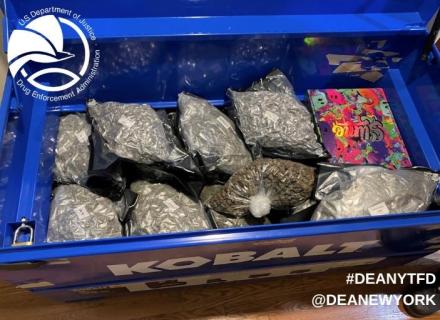
Two men were arrested on narcotics possession charges following an investigation that dismantled a major drug stash location near Yankee Stadium in the Bronx. A court authorized search of a residence located at 69 West 164th Street, Apt. 2, yielded a combined total of approximately 2.5 kilograms (over five pounds) of cocaine, ketamine, and MDMA, as well as approximately 30 pounds of psilocybin mushrooms, over 100 pounds of marijuana, and $85,000 cash. 
Seized Narcotics - DEANYTFD

Christopher Roberts, Special Agent in Charge of the U.S. Drug Enforcement Administration (DEA) New York Task Force Division, Bridget G. Brennan, New York City’s Special Narcotics Prosecutor, Bronx District Attorney Darcel D. Clark, New York City Police Commissioner Jessica S. Tisch, and New York State Police Superintendent Steven G. James announced charges against Eduardo RAMIREZ SALINAS and Jonathan FRANCO following arraignments in Manhattan Criminal Court, which occurred late on Thursday, April 30, 2026.

A criminal complaint filed by the Office of the Special Narcotics Prosecutor (SNP) initially charges both defendants with Criminal Possession of a Controlled Substance in the First and Third Degrees. Additional charges are anticipated. Bail was set for FRANCO in the amount of $25,000 cash/$25,000 bond. SALINAS was released on supervised release. 

The investigation was conducted by the DEA’s New York Task Force Division (NYTFD) Group T-43 and the Office of the Special Narcotics Prosecutor’s (SNP) Investigators Unit. NYTFD Group T-43 is comprised of agents and investigators with DEA New York Division, the New York City Police Department (NYPD), and the New York State Police.

“Once again, the DEA New York Task Force Division and our law enforcement partners successfully shut down another poly-drug network, resulting in the seizure of cocaine, MDMA, ketamine, as well as over 30 pounds of psilocybin mushrooms and a large amount of drug proceeds,” said DEA Special Agent in Charge Christopher Roberts. “This operation, which was carried out in the Bronx, an area frequently exploited by drug traffickers, has disrupted another distribution network responsible for flooding our communities with dangerous narcotics. Every arrest and every operation is a step toward protecting our citizens and holding those poisoning our neighbors accountable. The DEA remains steadfast in its mission to safeguard our communities.”


Special Narcotics Prosecutor Bridget G. Brennan said, “It is alarming to recover tens of thousands of dollars’ worth of cocaine, ketamine and other illegal drugs, along with $85,000 cash in a residential neighborhood a few blocks from Yankee Stadium.  We will continue to work with the Bronx District Attorney and our partners in the DEA’s New York Task Force Division to stem the flow of dangerous drugs into our communities.”

Bronx District Attorney Darcel D. Clark said, “I commend my local, state and federal law enforcement partners, and Special Narcotics Prosecutor Bridget Brennan, for continued vigilance against illegal, dangerous drugs in our community. Five pounds of cocaine, ketamine, and MDMA (Ecstasy) and over 100 pounds of marijuana were intercepted, before very risky combinations of narcotics reached the streets, posing health risks.”

“The defendants in this case turned a Bronx home into a dangerous drug den, stashing more than 5 pounds of illegal poison — including cocaine, ketamine, and other narcotics — that threatened a thriving community,” said NYPD Commissioner Jessica S. Tisch. “Illegal drug trafficking rings that place New Yorkers at risk have no business in our city. Thanks to our NYPD detectives, along with all our law enforcement partners, this pipeline has been dismantled and those responsible are being held accountable.” 

At approximately 9:15 a.m. on Thursday, April 30, agents and investigators entered 69 West 164th Street, Apt. 2, a three-bedroom duplex within a split family home. Both defendants allegedly reside at the location and were home at the time of the court authorized search. FRANCO was on the ground level of the residence, while SALINAS was in an upstairs bedroom. 

Agents and investigators discovered a large stash of drugs in an upstairs room that FRANCO allegedly used as an office. Large quantities of psilocybin mushrooms and marijuana were allegedly out in the open. A metal crate in the upstairs hallway near the bedrooms contained large quantities of marijuana, including bulk quantities in clear bags and numerous individual packets, including edibles. 

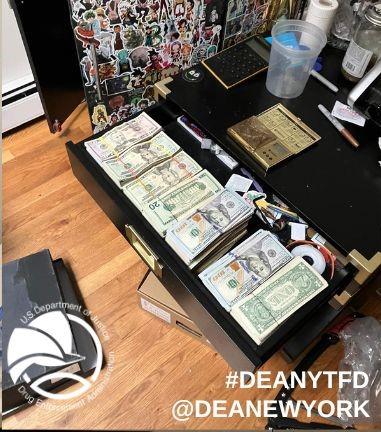
A kilogram of cocaine (over two pounds) was allegedly inside a closet in the office, while additional quantities of cocaine were plainly visible in the room. More than 1.5 kilograms of ketamine (over three pounds) and MDMA in pill and powder form were also in the room. Stacks of cash bound in rubber bands totaling approximately $85,000 were neatly stacked on a desk near a money counting machine inside the office. 
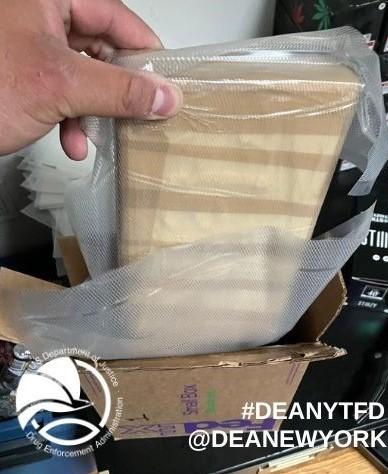
Seized Cocaine from NYC Stash House

Cash in Drawer in Stash House NYC

The results of DEA laboratory analysis on the recovered substances are pending.

Special Narcotics Prosecutor Bridget Brennan thanked Bronx District Attorney Darcel D. Clark, and commended SNP’s Special Investigations Bureau and Investigators Unit, the DEA New York Task Force Division, the New York City Police Department, and the New York State Police for their work on the investigation.

Defendants 

Charges 

Eduardo Ramirez Salina 

Bronx, NY 

Age: 40 

CPCS 1st – 1 ct 

CPCS 3rd – 1 ct 


Jonathan Franco 

Bronx, NY 

Age: 35 

CPCS 1st – 1 ct 

CPCS 3rd – 1 ct 


The charges and allegations are merely accusations, and the defendants are presumed innocent until proven guilty.


Monday, May 4, 2026

Two Sentenced to Prison for $522M Genetic Testing Fraud and Illegal Kickback Scheme Targeting Medicare and Medicaid


Two men were sentenced today for their roles in a scheme to defraud Medicare, Medicaid, and private health insurance companies by submitting over $522 million in fraudulent claims for medically unnecessary genetic tests that were obtained through the payment of illegal kickbacks and bribes.

Reyad Salahaldeen, 57, of Buford, Georgia, was sentenced to 151 months in prison after pleading guilty to conspiracy to commit health care fraud and wire fraud. Mohamad Mustafa, 28, of Duluth, Georgia, was sentenced to three years in prison after pleading guilty to paying health care kickbacks.

“Under the guise of health care, these two fraudsters attempted to steal more than half a billion dollars from taxpayers through a web of sham contracts, lies, and bribes,” said Colin M. McDonald, Assistant Attorney for the National Fraud Enforcement Division. “These schemes deplete America’s pocketbook and destroy the trust in medicine that patients deserve and demand. The Department of Justice will remain vigilant in our efforts to deter those defrauding the American people in the name of health care. I thank the prosecutors and our law enforcement partners at FBI and HHS-OIG who worked tirelessly for this just outcome.”

According to court documents, Salahaldeen controlled four laboratories, Express Diagnostics, LLC, in New Jersey (Express); BioConfirm Laboratory USA, LLC and BioConfirm Laboratories, LLC, in Georgia (BioConfirm); and Tox Management, LLC and Tri-State Toxicology, LLC, both in Texas. From 2018 through August 2020, Salahaldeen and co-conspirators paid kickbacks and bribes to a network of purported “marketers” who targeted individuals covered by Medicare, Medicaid, and private insurance and induced them to provide their health insurance information and DNA samples in order to obtain costly genetic tests designed to predict the risk of cancer, adverse drug reactions, and other conditions. The marketers obtained DNA samples through telemarketing, door-to-door solicitation, appearances at health fairs, and other methods of in-person solicitation. Further, the marketers, at the direction of Salahaldeen and co-conspirators and in exchange for kickbacks and bribes, obtained fraudulent laboratory requisition forms for the tests from medical providers who had not treated or consulted with the beneficiaries, and did not use the test results in treatment. As part of the scheme, Salahaldeen falsified laboratory requisition forms, letters of medical necessity, and other medical records to make the tests appear legitimate.

After the indictment was returned and he learned of the warrant for his arrest, Salahaldeen sought to evade law enforcement by traveling from North Carolina to Texas, where he attempted to enter Mexico. Salahaldeen was apprehended at the border when he falsely presented another person’s identification in a further attempt to evade arrest and prosecution.

Mustafa, who controlled Express and BioConfirm with Salahaldeen, participated in the scheme by paying kickbacks and bribes to various marketers to induce them to obtain DNA samples and fraudulent test requisition forms from medical providers. To conceal the scheme, Mustafa and Salahaldeen created sham contracts, invoices, and other documentation that disguised the illegal kickbacks and bribes as payments for purported marketing services.

The four laboratories billed approximately $522 million in false and fraudulent claims, of which Medicare, Medicaid, and private insurers paid approximately $84 million.

In addition to the prison sentences, Salahaldeen was ordered to pay $84,594,165 in restitution and to forfeit $3,044,866 from two bank accounts, a 2019 GMC Yukon, and properties in Texas and Georgia. Mustafa was ordered to pay $64,301,569 in restitution.

Eleven of Salahaldeen and Mustafa’s co-conspirators previously pleaded guilty in connection with this fraud scheme and were sentenced as follows:

  • Travores Wills, a marketer, was sentenced to 46 months in prison
  • Elijua Watson, a marketer, was sentenced to 27 months in prison
  • Diego Pancha Valencia, a marketer, was sentenced to 26 months in prison
  • Shauntae Walker, a nurse practitioner, was sentenced to 24 months in prison
  • Cassandra Latham, a nurse practitioner, was sentenced to 21 months in prison
  • LaTosha McCune, a marketer, was sentenced to 18 months in prison
  • Vinit Patel, a medical doctor, was sentenced to 12 months in prison
  • Jose Rodriguez Ospina, a medical doctor, was sentenced to 12 months in prison
  • Edward Giles, a marketer, was sentenced to 12 months in prison
  • Derek McCune, a marketer, was sentenced to 12 months in prison
  • Nelson Giraldo, a medical doctor, was sentenced to 6 months of house arrest and 3 years of probation

Assistant Attorney General Colin M. McDonald of the Justice Department’s National Fraud Enforcement Division; Acting Deputy Inspector General for Investigations Scott J. Lampert of the U.S. Department of Health and Human Services, Office of Inspector General (HHS-OIG); and Acting Special Agent in Charge Peter Ellis of the FBI’s Atlanta Field Office made the announcement.

HHS-OIG and FBI investigated the case.

Acting Principal Assistant Chief Rebecca Yuan and Acting Assistant Chief Gary A. Winters of the Criminal Division’s Fraud Section prosecuted the case.

On April 7, the Department of Justice announced the creation of the National Fraud Enforcement Division ('Fraud Division'). The Fraud Division is laser-focused on investigating and prosecuting those who commit fraud against the American people. The Department’s work to combat fraud supports President Trump’s Task Force to Eliminate Fraud, a whole-of-government effort chaired by Vice President J.D. Vance to eliminate fraud, waste, and abuse within Federal benefit programs.

The Department of Justice’s Health Care Fraud Strike Force Program, currently comprised of eight strike forces operating in federal districts across the country, has charged more than 6,200 defendants who collectively billed federal health care programs and private insurers more than $45 billion since 2007. In addition, the Centers for Medicare & Medicaid Services, working in conjunction with the Office of the Inspector General for the Department of Health and Human Services, are taking steps to hold providers accountable for their involvement in health care fraud schemes. More information can be found at www.justice.gov/criminal-fraud/health-care-fraud-unit.

Dominican Republic National Pleads Guilty To Possession Of Ammunition By An Illegal Alien In Connection With Shooting Of Off-Duty Federal Customs And Border Protection Officer


United States Attorney for the Southern District of New York, Jay Clayton, Special Agent in Charge of the New York Field Office of Homeland Security Investigations (“HSI”), Michael Alfonso, and Director of the New York Field Office of U.S. Customs and Border Protection (“CBP”), Frank Russo, announced today that MIGUEL FRANCISCO MORA NUNEZ pled guilty to possessing ammunition as an illegal alien in connection with the July 19, 2025, shooting of an off-duty CBP Officer in Manhattan.  MORA NUNEZ pled guilty today before U.S. District Judge Loretta A. Preska and is scheduled to be sentenced on September 1, 2026. 

“Miguel Mora Nunez shot a federal officer in the face,” said U.S. Attorney Jay Clayton. “Gun-toting criminals threaten our families, our communities, and our law enforcement professionals, who strive every day to keep us safe.  New Yorkers want criminals who use guns off the streets, and we are committed to delivering that result.” 

“Last year's shooting of an off-duty CBP officer was an attack on the greater law enforcement community and on the rule of law itself, and this guilty plea is a significant step toward holding the defendant accountable and making clear that such violence will not be tolerated,” said HSI Special Agent in Charge Michael Alfonso.  “Together with our vital partners, HSI New York will continue to disrupt and dismantle criminal networks, ensuring our city, and our country, remain safe.”

“This guilty plea is an important step toward accountability for a brazen act of violence against one of our officers,” said CBP’s Director of New York Field Operations Frank Russo.  “Our focus remains on the well-being and recovery of our colleague, and on safeguarding the men and women who serve our communities every day.  We are grateful to the U.S. Attorney’s Office, Homeland Security Investigations, and the NYPD for their exceptional work.  Their continued partnership helps keep New York City safer and ensures that those who commit violent acts are brought to justice.”

As alleged in the charging instruments and statements made in public filings and public court proceedings:

On or about July 19, 2025, at approximately 11:50 p.m., MORA NUNEZ shot an off-duty CBP Officer in Fort Washington Park in Manhattan.  A bullet MORA NUNEZ fired struck the CBP Officer in the face and right arm.  The CBP Officer appeared to return fire, hitting MORA NUNEZ twice, before MORA NUNEZ fled on a motorbike driven by his co-defendant.

MORA NUNEZ entered the U.S. illegally, is in the U.S. unlawfully, and is subject to an order of removal from the U.S.

MORA NUNEZ, 22, of the Dominican Republic, pled guilty to one count of possession of ammunition as an illegal alien, which carries a maximum sentence of 15 years in prison.

The maximum potential sentence in this case is prescribed by Congress and provided here for informational purposes only, as any sentencing of the defendant will be determined by the judge.

Mr. Clayton thanked Homeland Security Investigations, CBP, and the New York City Police Department for their assistance in this case.

NYPD ANNOUNCES FEWEST MURDERS IN RECORDED HISTORY FOR THE FIRST FOUR MONTHS OF THE YEAR AND IN APRIL


Shooting Incidents and Shooting Victims Declined Double Digits Compared to Last April

Major Crime Declined 9.5% Citywide

Safest Start to the Year in Public Housing in Recorded History with Fewest Murders, Shooting Incidents, Shooting Victims, and Robberies

Police Commissioner Jessica S. Tisch today announced that the NYPD delivered the fewest murders in recorded history for the first four months of the year and the month of April. During the four-month stretch, there were 76 murders, shattering the previous record of 86 set in 2018. April also saw the fewest murders in recorded city history with 19, beating the previous record of 21 set in 2014 and 2017.

Shooting incidents and shooting victims are down double digits compared to last April with an 18.6% and 19.3% decline, respectively.

Major crime continued to fall in April, down 9.5% citywide. These historic reductions extended to the city’s public housing developments, where the NYPD delivered the safest start to any year in recorded history with the fewest murders, shooting incidents, shooting victims, and robberies.

“Once again, the crime reductions across the five boroughs are a direct result of our precision policing strategy: focusing on illegal guns, putting officers where they’re needed most, and taking down violent gangs,” said NYPD Commissioner Jessica S. Tisch. “These results are made possible by the women and men of the NYPD carrying out that work with focus and discipline. That approach is producing real, measurable crime reductions across the city, and it will continue to guide our work in the months ahead.”

Citywide, overall major crime fell 9.5% (9,157 vs. 10,114) with 957 fewer reported crimes compared to last April. Year to date, major crime is down in all five boroughs, transit, and housing.

Compared to last April, shooting incidents declined 18.6% (57 vs. 70) and shooting victims dropped 19.3% (67 vs. 83). The NYPD’s ongoing work to target and take down the most dangerous gangs also played a role in driving down shootings and removing guns from the streets. So far this year, NYPD detectives have carried out ten gang-related takedowns, and the department has seized 1,600 guns.

Murders fell by a staggering 40.6% (19 vs. 32) citywide, marking the fewest murders for any April on record. Staten Island has had zero murders so far in 2026.

Additionally, for the month of April:

  • Burglary declined 21.5% (827 vs. 1,053), marking the fewest ever for any April in recorded history.
  • Auto theft fell 20.2% (962 vs. 1,205).
  • Robbery decreased 13.8% (1,053 vs. 1,222).
  • Felony assault declined 6% (2,426 vs. 2,580).
  • Grand larceny fell 4.4% (3,684 vs. 3,853).

Retail theft continued to plunge, falling 17.7% (3,680 vs. 4,471) in April compared to the same period last year. The decline reflects the department’s focused approach: identifying crime patterns, deploying resources at high-propensity locations during peak hours, and shifting from pass-through enforcement to sustained investigations.

The rise in reported rape incidents can be partially attributed to legislative changes enacted in September 2024 through the Rape is Rape Act, which rightfully broadened the legal definition of rape in New York State to include additional forms of sexual assault. The number of reported rapes increased by 10.1% (186 vs. 169) compared to April 2025 with 23% (43) of all reported rapes resulting from the expanded legal definition while 45.7% (85) occurred outside of April 2026. Year to date, rapes have increased 10.4% (711 vs. 644) with 21% (149) resulting from Rape is Rape and 33.5% (238) from outside 2026. Additionally, the NYPD has enhanced its work with advocates to encourage all survivors of sexual assault to come forward and report these incidents.

The NYPD is delivering historic crime reductions in public housing across the city. Year to date, overall crime in public housing is down 8.7% (1,721 vs. 1,886). So far this year, murders are down 41.7% (7 vs. 12), shooting victims are down 30.4% (32 vs. 46), shooting incidents are down 26.8% (30 vs. 41), and robberies are down 23.7% (225 vs. 295). In April, overall crime declined 16.7% (435 vs. 522).

Below ground, transit crime is down year-to-date by 0.6% (711 vs. 715). In April, overall transit crime increased by 1.2% (173 vs. 171) with only two more incidents.

The Bronx is the leading the city with the largest decline in major crime for the month of April and year-to-date with a 15.5% (2,218 vs. 2,626) and 10.7% (8,556 vs. 9,576) decrease, respectively. The Bronx had its fewest murders in recorded history for the month of April with four. Shooting incidents are down 58.1% (13 vs. 31), the second fewest in recorded history for the borough and only two behind the record set in April 2018. Shooting victims declined 64.9% (13 vs. 37). Robbery fell 23.5% (316 vs. 413) with nearly 100 fewer incidents. Finally, the Bronx saw the greatest reduction in auto theft, falling 43.8% (222 vs. 395) with 173 fewer incidents. Last month, NYPD detectives successfully dismantled and took down a major Bronx auto theft ring responsible for victimizing 252 vehicle owners with stolen property totaling $1.2 million.

To address youth violence, the department implemented its Youth Violence Safety Zones, modeled after the Violence Reduction Plan. These zones focus on the areas where young people are most at risk — commuter corridors, bus stops, and routes to and from school. Since its inception in September 2025, overall youth-related crime is down 52.4% (159 vs. 334), shooting incidents are down 64.7% (6 vs. 17), and shooting victims are down 63.2% (7 vs. 19) in the zones during deployment hours. In Bronx youth zones, there have been zero shootings.

The NYPD’s Hate Crime Task Force (HCTF) investigates allegations of hate crimes and bias motivated incidents. After an incident is flagged as a possible hate crime, the HCTF investigates and determines, in consultation with the NYPD Legal Bureau, whether it constitutes a hate crime under New York State law. If an incident is deemed a hate crime under the law, it will be categorized as a confirmed hate crime. The NYPD is providing data on confirmed hate crimes along with the universe of reported hate crimes — whether or not they are ultimately confirmed as hate crimes by the HCTF. The disclosure of both sets of numbers enhances transparency and reflects best practices in connection with hate crime reporting.

In April 2026, the HCTF confirmed 50 incidents as hate crimes out of 65 incidents that were reported as hate crimes. Confirmed hate crimes are down 35.1% (50 vs. 77), compared to the previous April.

The NYPD continues to combat violent crime and shootings through its data-driven zone strategy. Since launching the Winter Violence Reduction Plan in January, major crime is down 22.7% (899 vs. 1,163), shooting victims are down 66% (16 vs. 47), and shooting incidents are down 62.5% (15 vs. 40) in the zones during deployment hours. Starting today, the NYPD will begin its Summer Violence Reduction Plan, the department’s largest summer deployment in recorded history. The zones will deploy up to 3,800 officers on nightly foot posts across 72 zones in 40 precincts, public housing and the subway system.

*All crime statistics are preliminary and subject to further analysis, revision, or change. *

Index Crime Statistics: April 2026


April

2026

April

2025
+/-% Change
Murder1932-13-40.6%
Rape1861691710.1%
Robbery1,0531,222-169-13.8%
Felony Assault2,4622,580-154-6.0%
Burglary8271,053-226-21.5%
Grand Larceny3,6843,853-169-4.4%
Grand Larceny Auto9621,205-243-20.2%
TOTAL9,15710,114-957-9.5%

Additional Statistics: April 2026


April

2026

April

2025


+/-

% Change
Transit
17317121.2%
Housing
435522-87-16.7%
Shooting Incidents
5770-13-18.6%


AS WESTERN NY SEES RECORD HIGH GROCERY COSTS, SCHUMER ANNOUNCES LANDMARK LEGISLATION TO BREAK UP THE MEATPACKING MONOPOLIES, HELP FARMERS, AND DRIVE DOWN COST OF MEAT FOR FAMILIES


Schumer Says Four Corporate Giants Dominate Meat Market, Squeezing Farmers And Ranchers Who Keep Just 16 Cents Of Every Dollar Spent On Food, And Rigging The System Against WNY Families

New Schumer Bill Will Break Up Big Monopolies In Meat Packing That Lead To Higher Prices And Restore Real Competition To Lowering Costs

Schumer: New Bill Will Bring Down Costs For Families At The Grocery Store

As Western New Yorkers face some of the fastest price growth for groceries in the country, U.S. Senator Chuck Schumer today stood with Western New York farmers and families at the beloved Niagara Sausage Company to introduce the Family Grocery and Farmer Relief Act. The Senator’s new landmark legislation would break up the big meat monopolies, boost farmers Upstate, and lower grocery costs for families.

“The meatpacking monopoly is driving up costs for Western New Yorkers at the grocery store and rigging the game against local farmers. Corporate giants dominate the meat market and set prices sky-high for families, all while squeezing profits from farmers by eliminating competition, and it needs to end,” said Senator Schumer. “That’s why I’m introducing legislation – the Family Grocery and Farmer Relief Act – to break up the monopoly and lower costs. This bill is centered around making groceries more affordable, making farmers more profitable, and putting the needs of working middle-class people ahead of the interests of powerful corporations. Local businesses like Niagara Sausage Company are the backbone of communities; they love their customers and want prices to be affordable, and they get hurt by big corporations and suppliers rigging the game against consumers. America’s economy and our Main Streets are stronger when costs are lower and we have true competition, and this bill will do exactly that.”

Recent reporting shows that families in the Buffalo area are spending some of the most on groceries in the country. Families in Buffalo spend the eighth largest percentage of their income on groceries in an analysis of 100 of the largest American cities. According to analysis from the Urban Institute, New York’s 26th Congressional District, which covers parts of Erie and Niagara Counties, has experienced some of the fastest price growth for groceries in the country in the past ten years. Grocery prices have increased from $758.95 to $1,149.02 each month, a whopping more than 50% increase.

Schumer explained that a major driver of high meat prices is a food system rigged in favor of corporate monopolies. Four companies, Tyson Foods, JBS, Cargill, and National Beef, control 85% of the beef market, 67% of the pork market, and 60% of the chicken market.

Schumer’s Family Grocery and Farmer Relief Act is a competition-driven, pro-farmer, pro-rancher, pro-worker, pro-consumer, cost-of-living bill that breaks up dominant meatpackers and uses all available tools to stop unfair pricing that drives up grocery bills for American families. The bill would force the biggest meatpackers to choose a line of business instead of dominating beef, pork, and chicken all at once, and aims to provide financial and technical assistance to farmers’ cooperatives and small businesses that seek to acquire, operate, or expand meatpacking plants or facilities, helping make more local supply chains to lower costs. In addition, to directing the FTC to go after foreign-controlled conglomerates that squeeze American producers and distort U.S. markets.

Justice Department Files Complaint Against Minnesota Over Its Attempt to Override Federal Law


The Justice Department today filed a complaint against the State of Minnesota over its attempt to regulate global greenhouse gas emissions, which are subject to exclusive federal authority, and override the policy choices of the United States and other states to make energy affordable and reliable. The filing advances President Donald J. Trump’s executive order directing the Justice Department to protect American energy from state overreach. Specifically, the complaint seeks to stop the enforcement of Minnesota’s state court lawsuit that usurps exclusive federal authority and unreasonably burdens domestic energy development. 

“President Trump promised to unleash American energy dominance, and Minnesota officials cannot undermine his directive by mandating that their woke climate preferences become the uniform policy of our Nation,” said Associate Attorney General Stanley Woodward. “Minnesota’s attempt to impose a national regulation on global greenhouse gas emissions not only is preempted by federal law, but also undermines affordable and reliable American energy, weakening the national and economic security of the United States.” 

“The case we filed against Minnesota today is an attempt to rein in another unconstitutional state effort to invade an area of exclusive federal control,” said Principal Deputy Assistant Attorney General Adam Gustafson of the Justice Department’s Environment and Natural Resources Division (ENRD). “It is in America’s interest to have independent and secure sources of energy. Minnesota’s attempted overreach would undermine our economic and national security to advance the climate agenda of politicians and activists.” 

According to the complaint filed today in U.S. District Court for the District of Minnesota, the state of Minnesota is attempting to regulate global greenhouse gas emissions by suing energy companies in state court to enjoin global energy production and compel them to disgorge their profits. As Judge Stras of the Eighth Circuit has recognized, such efforts to “set national energy policy” and “change the companies’ behavior on a global scale” are “beyond the limits of state law.” 

These efforts are also preempted by the Constitution and the Clean Air Act. Last year, ENRD filed complaints against Hawaii, Michigan, New York, and Vermont to stop those states’ unconstitutional climate actions. 

Chief of Staff and Senior Counsel John Adams of ENRD filed the complaint. 

Mamdani Administration, Rep. Ritchie Torres Announce $2 Million to Expand Free Broadband Internet Access


Funding will expand the Neighborhood Internet program to give low-income New Yorkers access to high-speed internet   

Today, Mayor Zohran Kwame Mamdani, U.S. Representative Ritchie Torres, The New York Public Library (NYPL) President Anthony W. Marx and Housing Preservation and Development (HPD) Commissioner Dina Levy celebrated a $2 million expansion of the Neighborhood Internet program at an affordable housing development in the Bronx. 


Neighborhood Internet is a groundbreaking partnership between the City and NYPL that extends free, high-speed broadband to low-income New Yorkers. The initial pilot of the program, funded by HPD, will serve over 700 low-income households in the Bronx and Upper Manhattan by this summer, with the federally-funded expansion supporting thousands more across the Bronx over the next two years.  


“Internet access allows New Yorkers to access jobs, find no-cost child care and explore the city they love. But for too many, broadband connection is either unreliable or unattainable. With this $2 million investment in the Neighborhood Internet program for New Yorkers in affordable housing, this administration is taking a major step towards closing the digital gap and building a city that is connected in more ways than one,” said Mayor Mamdani 


“The digital divide is not abstract, it is a daily barrier for so many families in the South Bronx,” said Rep. Torres. “In 2026, being offline means being locked out of opportunity. This $2 million investment will bring high-speed internet into thousands of apartments, because in today’s economy, you cannot fully participate without being connected. I’m grateful to the Mayor, HPD and The New York Public Library for partnering with us to deliver this critical investment to the Bronx.”  


“The New York Public Library is laser focused on promoting reading and free access to digital information,” said Anthony W. Marx, President and CEO of The New York Public Library. “From applying for jobs, to staying connected to loved ones, finding a family doctor, and so much more, the internet is essential to fully participating in society. The Library is committed to closing the digital divide and we are proud to help the City of New York deliver free wifi into the homes of New Yorkers in need.”  


“When affordable housing gets built in the city, residents should be connected to the internet,” said Dina Levy, Commissioner of the Department of Housing Preservation and Development. “Forty percent of households in the Bronx do not have home internet access. The Neighborhood Internet initiative will help bridge the digital divide, providing low-income tenants in the Bronx with free access to the internet. Thank you to Congressman Torres for securing the federal funding that makes this possible, and to NYPL for their partnership in expanding internet access across the city. Under Mayor Mamdani, we’re making sure affordable housing tenants are first to get connected.”  


“New Yorkers across the five boroughs deserve the same access to affordable internet regardless of their zip code,” said New York City Chief Technology Officer and Office of Technology and Innovation Commissioner Lisa Gelobter. “Today’s announcement is about more than free internet — it’s about connecting thousands of historically underserved Bronx residents to greater economic, educational and social opportunities. We’re proud to join Rep. Torres, HPD, and The New York Public Library to celebrate the expansion of the Neighborhood Internet program, a key initiative of the NYC Digital Equity Roadmap, and look forward to working closely with the public and our various stakeholders as we develop the ‘Citywide Broadband Adoption Plan’ in the coming months.”  


Neighborhood Internet, which is the first program of its kind in the country, serves low-income New Yorkers in the South Bronx and Upper Manhattan, which have among the lowest rates of broadband access in the five boroughs. Eligible households receive free, high-speed Internet access managed by The Library as part of its mission to provide free access to knowledge and information to all.  


The expansion is funded by $2 million secured by Rep. Torres in Fiscal Year 2026 Community Project Funding. The funding will cover microtrenching, rooftop network equipment installation, dedicated internet access infrastructure and in-unit connectivity for thousands of homes across 50 buildings. The New York Public Library is a key implementation partner in installing and managing the high-speed internet.  


Mayor Mamdani, Rep. Torres, NYPL, and HPD celebrated the additional funding at St. John’s House II, an affordable housing development near Melrose Library, where Neighborhood Internet was recently installed.