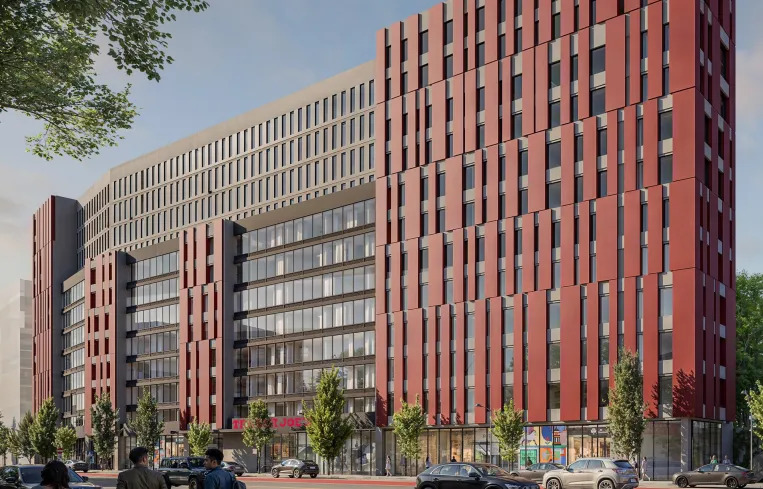
Governor Kathy Hochul today announced the start of construction at North Aud Block, a $225 million mixed-use development in Buffalo’s Canalside. This transformative project will convert a vacant parcel into 251 affordable and market-rate apartments, and will include 18,000 square feet of commercial space, 20,000 square feet of open, community space and 137 parking spaces. The project is built on the site of the former Buffalo Memorial Auditorium, also known as the Aud, which closed in 1996. It is part of a comprehensive plan to redevelop the entire parcel of land where the Aud once stood and follows last year’s opening of a visitor center there. Under Governor Hochul’s leadership, New York State Homes and Community Renewal (HCR) has created or preserved more than 11,600 homes in Erie County, including more than 8,300 in the city of Buffalo. North Aud Block continues this effort and is part of Governor Hochul’s $25 billion five-year Housing Plan, which is on track to create or preserve 100,000 affordable homes statewide.
“For too long, the North Aud Block has sat in the shadow of Canalside as a vacant reminder of the past, but today, we are rewriting its future as a vibrant destination on Buffalo’s historic waterfront,” Governor Hochul said. “This transformation represents exactly what our strategy was designed to achieve: turning underutilized land into hundreds of new homes and enhancing an important economic corridor. By honoring Buffalo’s rich history while investing in the future, we are ensuring Canalside remains a premier, welcoming destination for generations to come.”
North Aud Block, developed by Pennrose, will appeal to families of varying sizes and income levels. It will feature 187 affordable units available to households earning up to 80 percent of the Area Median Income. The remainder of the apartments will be market-rate. There will be a mix of studios, one-, two- and three-bedroom units.
The project’s design will retain the site’s connection to the former auditorium and will reflect portions of the area’s original 19th-century street grid. The facades will incorporate exposed brick, terracotta and metal paneling. The ground floor will consist of stone materials reminiscent of other historic downtown buildings nearby.
The buildings will be situated on the site to create a 20,000-square-foot public plaza along the canal, including seating and landscape features that will also serve as wind barriers and heat preservation. The open space will help connect the project to the surrounding Canalside neighborhood and KeyBank Center, home to the Buffalo Sabres and Buffalo Bandits.
While the project celebrates the historic Auditorium, it will incorporate 21st-century amenities. The development will be all-electric, with heat pumps, energy recovery ventilation, ENERGY STAR appliances, water-conserving plumbing and electric vehicle charging. It will have fully accessible and adaptable apartments. There will be 13 units to accommodate residents with mobility disabilities and six units to accommodate residents with sensory disabilities.
The Erie Canal Harbor Development Corporation, a subsidiary of Empire State Development (ESD), previously owned the North Aud Block site. The Aud was demolished by the state in 2009.
This project is part of the State’s plan to redevelop the entire former Buffalo Memorial Auditorium parcel of land. In November 2025, Governor Hochul announced the opening of The Chandlery, a visitor center and retail store. The 14,000-square-foot, four-story masonry building evokes 19th century structures along the Erie Canal. A public art installation, Destination, also debuted then in commemoration of the Erie Canal bicentennial.
North Aud Block is supported by HCR’s Federal Low-Income Housing Tax Credit program, which is expected to generate more than $30 million in equity, its State Low-Income Housing Tax Credit program, which is expected to generate more than $35 million in equity, and $65 million in subsidy. The project is also supported by Empire State Development with $12 million from the NY-RUSH program, $10 million from the NY Works Economic Development Fund, and $2.5 million from the Regional Council Capital Fund Program. The site is participating in the New York State Department of Environmental Conservation’s successful Brownfield Cleanup Program and, when completed, would be eligible for approximately $20 million in tax credits administered by the New York State Department of Taxation and Finance.