Thursday, August 13, 2026

Meat Processing Plant and Employees Charged with Conspiring to Violate the Clean Water Act and Discharging Pollutants in Puerto Rico


An indictment was unsealed charging César P. Borges-Arroyo, Neftalí Borges-Gómez, Erison Delgado-Santos, Héctor Fulgencio-Cabrera, and Ganaderos Borges Inc. (GBI), with four violations of the Clean Water Act as well as conspiring to violate the Clean Water Act. The charges relate to the discharge of pollutants from GBI into the waters of the United States. 

GBI is a corporation in Naguabo, Puerto Rico, that operates a slaughterhouse and meat processing plant. The operations encompass receiving and holding live animals for slaughter, butchering animals (bleeding), initial processing of animals, and operations that produce consumer-ready meat products. According to the indictment, the defendants conspired for the benefit of GBI, to knowingly discharge a pollutant — specifically wastewater from the meat processing waste retention lagoon — into waters of the United States without having obtained a Clean Water Act permit.

“We allege that this meat processing plant and at least four of its employees conspired to pump animal flesh, blood, and feces into a creek that flows to the ocean and a public beach,” said Principal Deputy Attorney General Adam Gustafson of the Justice Department’s Energy and Natural Resources Division (ENRD). “The conduct alleged here sacrifices public health for economic gain, and it is a crime. The Department of Justice will hold violators accountable.”

“GBI repeatedly and intentionally violated the Clean Water Act by discharging untreated wastes into the Caribbean Sea at Tropical Beach in Naguabo,” said Acting U.S. Attorney Héctor Ramírez Carbó for the District of Puerto Rico. “This prosecution sends the message that those who purposely undermine federal environmental laws and endanger the environment and Puerto Rico communities will face felony prosecution for their illegal conduct.”

“The defendants’ willfully disregarded the complete prohibition on discharges under the Clean Water Act and knowingly sent a disgusting sludge of animal blood and waste, and cleaning products into the Caribbean Sea, only miles from nature preserves, beaches, and a military base. Illegal discharges such as these cause serious harm, jeopardizing the safety and health of the water, wildlife, and human health,” said Assistant Administrator Jeffrey A. Hall for EPA’s Office of Enforcement and Compliance Assurance. “EPA will ensure that polluters who blight our communities and coastal waters will be held accountable.”

Starting in August 2018 and continuing through at least September 2025, GBI president Borges-Arroyo and GBI operator Borges-Gómez directed employees including, but not limited to, Delgado-Santos and Fulgencio-Cabrera to discharge liquid waste from GBI’s waste retention lagoon towards an adjacent creek. They did this by using a submersible pump placed in the waste retention lagoon and connected to a hose, attempting to avoid millions of dollars in annual waste removal costs. 

GBI generated waste from various on-site processes, including animal intake, slaughtering, hide removal, butchering, and cleaning. The waste included animal blood, hair, tissue, and feces, as well as grease, wastewater, disinfectant, and other liquids used inside the GBI slaughterhouse and processing areas. The mixed waste flowed from the facility to a discharge pipe that emptied into a waste retention lagoon located on the southwest corner of the GBI property. The western edge of the waste retention lagoon is adjacent to a creek which travels approximately half-a-mile to the Caribbean Sea at Tropical Beach in Naguabo, Puerto Rico. 

GBI held a non-discharge wastewater treatment permit that required liquid waste to be hauled from the facility to a disposal facility. At no time was any waste permitted to be discharged on-site or to any other body of water. The permit expired on July 31, 2019, and they continued to violate the Clean Water Act until at least September 2025.

To conceal the illegal waste discharge, the defendants hid the submersible pump and hose when it was not being used and provided false and misleading statements and documents to authorities to hide the illegal activities.

The defendants are scheduled to appear before Magistrate Judge Héctor Ramos Vega of the U.S. District Court for the District of Puerto Rico for their respective initial appearances. If convicted, they face a maximum penalty of five years in prison and $250,000 in fines for each charge. GBI faces a maximum penalty of $500,000 in fines per charge.

EPA’s Criminal Investigation Division investigated the case with assistance from the FBI. EPA and FBI participate in the Puerto Rico and U.S. Virgin Islands Environmental Crimes Task Force.

Senior Trial Attorney Patrick M. Duggan of ENRD’s Environmental Crimes Section and Assistant U.S. Attorney Seth A. Erbe for the District of Puerto Rico are prosecuting the case.

Report possible violations of environmental laws and regulations at epa.gov/tips, You can provide tips anonymously if you do not want to identify yourself.

An indictment is merely an allegation. All defendants are presumed innocent until proven guilty beyond a reasonable doubt in a court of law.

Louisville Man Sentenced to 16 Years in Prison for Distribution of Fentanyl and Firearm Offenses


A Louisville man was sentenced to 16 years in prison for distribution of fentanyl and possession of a firearm in furtherance of a drug trafficking crime. 

U.S. Attorney Kyle Bumgarner of the Western District of Kentucky, Special Agent in Charge John Nokes of the ATF Louisville Field Division, Special Agent in Charge Jim Scott of the DEA Louisville Field Division, and Chief Paul Humphrey of the Louisville Metro Police Department made the announcement.

Calvin Allen, 37, of Louisville, Kentucky, was sentenced to 16 years in prison, followed by 4 years of supervised release, for distribution of fentanyl and possession of a firearm in furtherance of a drug trafficking crime. 

On 9 different occasions between May and November 2025, Allen sold fentanyl powder to a confidential informant. The total amount of fentanyl from all of the controlled purchases was 712.84 grams. During a June 2025 drug transaction, Allen possessed a Glock GmbH, Model 29, 10-millimeter pistol in furtherance of the drug trafficking crime.

On November 24, 2025, a search warrant was executed at Allen’s residence. 60.26 grams of fentanyl powder, 13.32 grams of heroin and a Glock GmbH, Model 29, 10-millimeter pistol, and ammunition were seized. U.S. currency in the amount of $31,476.00 was seized as proceeds of drug trafficking during the execution of the search warrant. 

United States Attorney Kyle Bumgarner stated, “Allen’s lengthy sentence is commensurate with the danger posed by the fentanyl he trafficked into the Western District of Kentucky.  Too many families have lost loved ones to fentanyl or otherwise watched as a loved one suffered from deep drug addiction. Allen’s substantial sentence should give pause to others inclined to peddle fentanyl in Kentucky. Rest assured, our Office will not stop until the fentanyl is eradicated from our communities.” 

“Fentanyl trafficking combined with firearms is a lethal combination that ruins lives and destroys families,” said Special Agent in Charge Jim Scott, head of DEA’s Louisville Field Division. “I’m proud of the work done by DEA and our law enforcement partners to bring Mr. Allen to justice and prevent further harm to our community.”

“Many families have suffered enduring pain due to the drug epidemic across our country,” said Special Agent in Charge John Nokes of the Louisville Division. “ATF is committed to working with our law enforcement partners to pursue drug dealers who use guns and violence to exploit the vulnerabilities that addiction creates. Drug dealers with guns are violent criminals who pose an increased threat to the safety of our communities.”

"Fentanyl and illegal firearms are a dangerous combination that puts lives across Louisville at risk," said Louisville Metro Police Chief Paul Humphrey. "This sentence reflects the serious consequences for those who profit from distributing deadly drugs while armed. I’m grateful for the persistent work of our LMPD investigators and our federal partners at ATF, DEA and the U.S. Attorney’s Office. By working together, we are holding those who fuel violence and addiction accountable and making Louisville a safer place.”

There is no parole in the federal system.   

Bloods Member Sentenced to 27 Years in Prison for Gang-Related Shooting at Hamptons House Party and for Selling Fentanyl that Resulted in Death and Serious Bodily Injury


Defendant and Two Others Opened Fire Multiple Times at Hamptons House Party and Sold Fentanyl that Caused One Fatal and Two Non-Fatal Overdoses

Bloods member Joshua Crowell, also known as “Twiggy,” was sentenced by United States District Judge Gary R. Brown to 27 years in prison for assault in aid of racketeering and distribution of fentanyl that resulted in a death.  Crowell pleaded guilty to these charges in October 2025.

Joseph Nocella, Jr., United States Attorney for the Eastern District of New York; Raymond A. Tierney, District Attorney, Suffolk County District Attorney’s Office (SCDAO); Pete Gizas, Acting Special Agent in Charge, Department of Homeland Security, Homeland Security Investigations (HSI); and Kevin Catalina, Commissioner, Suffolk County Police Department (SCPD), announced the sentence. 

“Joshua Crowell committed acts of violence and sold lethal drugs on behalf of an extremely violent street gang,” stated United States Attorney Nocella.  “His criminal conduct left three people wounded by gunfire, claimed one life through a fatal overdose, and caused two others to suffer overdose-related injuries. Today’s sentence sends a clear and powerful message that those who terrorize our communities with gang violence and deadly drugs will be held fully accountable for the devastation they cause.”

“This defendant unleashed gunfire into a crowded Hamptons house party — wounding innocent people — and trafficked fentanyl that caused a fatal overdose and left others fighting for their lives,” stated HSI Acting Special Agent in Charge Gizas.  “Today’s sentence reflects the severe consequences of Joshua Crowell’s violent and deadly conduct.  These crimes inflicted profound harm on victims, families, and the Long Island community.  HSI New York, standing alongside our law enforcement partners, will not allow violent gangs to turn Long Island neighborhoods into battlegrounds or marketplaces for lethal drugs.”

"Crowell's actions display a selfish, blatant disregard for the safety of others," stated Suffolk County Police Commissioner Catalina.  "He prioritized financial gain by peddling deadly drugs and prioritized gang status over the safety of dozens of individuals.  It is my hope this sentence sends a message to others who put their greed above the well-being of the public." 

“This Bloodhound Brims defendant along with another gang member and an associate indiscriminately fired with pistols and an assault rifle at partygoers in Southhampton. Amazingly, despite three people being hit, no one was killed.  This could easily have been a mass murder,” stated Suffolk County District Attorney Tierney.  “I thank our federal and local partners for working together to make sure that this defendant was held responsible for that violence, as well as the destruction wrought by the poison sold and multiple overdose deaths caused by this defendant.  Suffolk County has no place for those who would terrorize our communities.  Today’s sentence delivers accountability and sends a clear message that we will use every available tool to bring violent criminals to justice.”

As set forth in the government’s sentencing memorandum and other court filings, the defendant was an avowed member of the Bloodhound Brims set of the Bloods street gang who openly embraced and promoted his affiliation, including through social media posts.  In furtherance of the gang’s criminal activities, he engaged in acts of violence and sold lethal drugs.  In March 2021, Crowell, along with another member and an associate of the Bloods, traveled to a party hosted by rival gang members at a rental home in Southampton, New York.  Upon arrival, they unleashed a barrage of nearly 50 rounds into the residence using two pistols and an AK-47 style assault rifle.  Three partygoers were struck by gunfire and injured, though all ultimately survived.

Additionally, Crowell and several co-conspirators operated a drug trafficking network that for years sold fentanyl, heroin, and cocaine.  His fentanyl sales had devastating consequences.  At least three individuals overdosed after purchasing fentanyl from Crowell, including one victim who died after using the deadly drug he supplied. 

The government’s case is being handled by the Criminal Section of the Office’s Long Island Division. 

Secretary Mullin Visits Coast Guard Base Kodiak, Future Home to New Arctic Security Cutters


USCG Base Kodiak is the largest U.S. Coast Guard base in the world 

United States Department of Homeland Security (DHS) Secretary Markwayne Mullin toured U.S. Coast Guard (USCG) Base Kodiak in Kodiak, Alaska. He was joined in his tour of the base by Admiral Kevin Lunday, Commandant of the Coast Guard, and Senator Dan Sullivan of Alaska.

“It was an honor to be at Air Station Kodiak and meet many of the men and women of the Arctic District. The Arctic is a crucial region for securing our Homeland, and soon this base will see an influx of resources, including an Arctic Security Cutter, that will further protect our interests in this region,” said Secretary Mullin. “Under President Trump’s leadership, the Coast Guard is receiving the recognition and support it has long deserved. Thanks to President Trump and his One Big Beautiful Bill, we have invested $25 billion into the Coast Guard– the largest single investment in its history. Today, the Coast Guard is stronger than it’s ever been.”

Alaska1

Alaska2

Secretary Mullin speaks to Coast Guard personnel at an all-hands meeting at USCG Air Station Kodiak

Secretary Mullin began his tour of the base by speaking to an all-hands meeting of approximately 300 Coast Guard personnel at Air Station Kodiak. At the all-hands meeting, Secretary Mullin recognized several USCG personnel who were nominated by their supervisors for demonstrating exceptional performance.

Alaska3

Secretary Mullin, U.S. Senator Dan Sullivan, and Commandant Lunday tour a pier at USCG Base Kodiak

Alaska4

Secretary Mullin and Commandant Lunday tour the new USCG Nemetz Housing in Kodiak

Secretary Mullin and Commandant Lunday then toured a pier, followed by a tour of the new USCG Nemetz Housing.

Alaska5

Alaska6

Alaska7

Secretary Mullin participates in a Coast Guard rescue swimmer demonstration

Secretary Mullin then concluded his visit with an aerial tour and a demonstration of a Coast Guard rescue swimmer operation.

Earlier this week, Secretary Mullin toured a U.S. Customs and Border Protection (CBP) cargo screening facility in Anchorage, Alaska, then met with Transportation Security Administration (TSA) workers at the Ted Stevens Anchorage International Airport.

11 Defendants Charged in Dismantling of Decade-Long Nationwide Marriage Fraud Scheme


A two-count indictment was unsealed charging 11 individuals with conspiring, over the course of more than a decade, to orchestrate more than 1,000 sham marriages to fraudulently obtain immigration status for foreign nationals, primarily citizens of the People’s Republic of China. Some individuals paid up to $100,000 per sham marriage, according to the indictment.

“This Department of Justice is rooting out fraud everywhere — including in our immigration system,” said Attorney General Todd Blanche. “The individuals who were arrested today allegedly orchestrated elaborate schemes to illegally obtain citizenship for foreign nationals through sham marriages. Schemes like this are a deliberate affront to the United States and our laws and will not be tolerated under the Trump Administration.”

“The defendants and their co-conspirators allegedly operated a nationwide and international, multimillion-dollar marriage fraud scheme, using participants to abuse United States immigration laws for their own profit,” said U.S. Attorney Jamie McDonald for the Southern District of New York. “These arrests have dismantled a central component of one of the largest marriage fraud schemes charged in United States history.  As this prosecution shows, we and our law enforcement partners will relentlessly pursue those seeking to corrupt and exploit our nation’s lawful immigration system.”

“Anyone willing to lie, cheat or steal their way to legal immigration status is a direct threat to America's national security,” said Director Joseph B. Edlow of U.S. Citizenship and Immigration Services (USCIS). “U.S. Citizenship and Immigration Services is aggressively pursuing marriage fraud schemes and the criminal organizations and ringleaders who profit from them. USCIS will continue to expose fraud, defend the rule of law, and ensure immigration status is reserved for those who truly qualify.”

“As alleged, this decade-long scheme turned marriage fraud into an international business model arranging countless sham marriages and causing hundreds of fraudulent Green Card applications to be submitted to United States Citizenship and Immigration Services,” said Acting Executive Associate Director John Condon of Homeland Security Investigations (HSI). “Through the Homeland Security Task Force, HSI and our partners will continue to dismantle criminal networks that undermine the rule of law, exploit federal laws, and profit from fraud.”

The defendants are:

  • Amy Cheng, also known as “Amy Zhou,” 72, of Brooklyn, New York;
  • Xiao Mei Chan, also known as “Carmen;” 64, of Queens, New York;
  • Christine Lu, also known as “Lily,” 52, of Queens;
  • Jing Yan Ye, also known as “Serene,” 43, of Staten Island, New York;
  • Xiao Yan Chen, also known as “Anna,” 48, of Brooklyn;
  • Gang Zheng, also known as “Michael” and “Mike,” 61, of Queens;
  • Anthony Cheng, 47, of Staten Island;
  • Michelle Duenas, 35, of Staten Island; 
  • Angela Duenas, 26, of Staten Island; 
  • Sigrid Cetino, 32, of Peekskill, New York; and 
  • Erika Johnson, 43, of Ossining, New York.

According to the indictment, from at least 2016 through July 2026, the defendants operated a nationwide and international marriage fraud network that arranged sham marriages between foreign nationals — primarily citizens of the People’s Republic of China — and United States citizens. Although based principally in New York City, the network allegedly arranged sham marriages throughout the United States and overseas including in Connecticut, Massachusetts, Pennsylvania, Kentucky, Tennessee, Georgia, Florida, Vanuatu, and China. 

The network included facilitators who oversaw the scheme and identified foreign-national customers; recruiters who found willing United States citizens and helped ensure their continued participation; and assistants who prepared immigration paperwork and coordinated the submission of fraudulent lawful permanent residency (Green Card) applications to U.S. Citizenship and Immigration Services (USCIS). The scheme also relied on marriage officiants, attorneys, tax preparers, insurance providers, and other service providers.  

Foreign nationals paid facilitators as much as approximately $100,000 for a sham marriage and assistance obtaining lawful permanent resident status. Facilitators, in turn, allegedly paid participating U.S. citizens up to about $30,000 — generally in installments tied to milestones in the Green Card application process — and paid recruiters commissions of as much as approximately $5,000 for each citizen recruited. In total, the defendants and their co-conspirators recruited hundreds of U.S. citizens to enter into sham marriages.

Sham marriage 1

A foreign national (left), Anthony Cheng (center), and Erika Johnson (right) in a sham marriage ceremony on or about Jan. 15, 2025. From the indictment.

Sham marriage 2

Sigrid Cetino (left), Anthony Cheng (center), and a foreign national (right) in a sham marriage ceremony on or about Dec. 17, 2024. From the indictment.

The defendants executed the fraud by pairing foreign nationals with U.S. citizens. The individuals would often meet for the first time immediately before obtaining a marriage license, arranging sham wedding ceremonies, and staging photographs designed to make those marriages appear legitimate. Some examples are below, including a photograph of a sham marriage that took place in China:

Sham marriage banquet

Photo from a sham wedding banquet, from the indictment.

Staged photo

A couple’s staged photo, from the indictment.

After the ceremonies, scheme participants manufactured evidence to make the marriages appear genuine, including by staging additional photographs, opening joint financial and utility accounts, filing joint tax returns, and obtaining insurance policies. The defendants and their co-conspirators then prepared and submitted Green Card applications containing materially false statements and, when interviews with USCIS were required, coached the marriage participants on how to conceal the true nature of their relationships and provide false answers to immigration officers. 

The defendants caused at least hundreds of fraudulent Green Card applications and supporting documents to be submitted to USCIS. Based on the scale and duration of the scheme, the defendants’ network is believed to have collected tens of millions of dollars from foreign nationals seeking lawful permanent resident status.

At the time the defendants were arrested, law enforcement executed premises search warrants at multiple locations in New York including Sunset Park, Brooklyn, and Flushing, Queens.

The defendants have each been charged with one count of conspiracy to commit marriage fraud and immigration fraud, which, if convicted, carries a maximum penalty of five years in prison. The defendants have also each been charged with one count of conspiracy to encourage the unlawful residence of aliens in the United States, which, if convicted, carries a maximum penalty of 10 years in prison.

HSI, Hudson Valley; the FBI, Safe Streets Task Force; the USCIS’s Fraud Detection and National Security Directorate; the U.S. Army Criminal Investigation Division; and the Westchester County District Attorney’s Office are investigating this case. 

Assistant U.S. Attorneys Jake Sidransky and Reyhan Watson for the Southern District of New York are prosecuting the case.

An indictment merely contains accusations. All defendants are presumed innocent until proven guilty beyond a reasonable doubt in a court of law.

NYC Comptroller Levine and Pension Trustees Announce Robust 13% Pension Aggregate Return for Fiscal Year 2026


Funds now valued at a combined $326.3 billion

Returns significantly outpace actuarial target of 7.0% and reduce City pension obligations by an estimated $6.3 billion over five fiscal years

 New York City Comptroller Mark Levine and the trustees of the five New York City retirement systems (Systems) announced an aggregate 13% investment return net of fees across the five Systems for the fiscal year ending June 30, 2026. The Systems are now valued at $326.3 billion, reflecting strong performance amid a complex investment landscape marked by evolving trade policy, persistent inflation, geopolitical uncertainty, and continued investment in artificial intelligence.

The past fiscal year’s performance surpasses the 7.0% actuarial target and reduces the City’s required pension obligations by approximately $6.3 billion over five fiscal years beginning in FY28.

“Retirees work for decades to earn the financial security that a pension provides and protecting that security requires a disciplined and prudent investment approach. Global markets faced significant headwinds over the past year, and our results demonstrate the importance of maintaining a long-term focus and a diversified strategy designed to deliver sustainable, risk-adjusted returns for decades to come,” said New York City Comptroller Mark Levine.

The five systems – the New York City Teachers’ Retirement System, Employees’ Retirement System, Police Pension Fund, Fire Pension Fund, and Board of Education Retirement System – posted an annualized average three-year return of 11.1%, five-year return of 6.2%, seven-year return of 8.6% and 10-year return of 8.9%.

NYC Combined Systems Annualized Returns, Net of Management Fees

The funds maintain a disciplined, diversified, and long-term investment strategy to ensure appropriate risk-adjusted returns. They have 43% invested in Public Equities, 25% in Public Fixed Income (i.e. Government and Corporate Bonds), and about 22% in Private Markets Alternatives (including Private Equity, Real Estate, Alternative Credit, Infrastructure, and Hedge Funds) and cash.

The Systems’ public market investments, which represent more than 74% of the Systems’ assets, generated strong gains for the Systems across both equities and fixed income as the principal contributor to investment performance. The solid performance of public markets was driven in large part by emerging markets equity investments led by the information technology sector. Fixed income market investments also experienced positive gains, supported by higher starting yields, strong investor demand and historically tight credit spreads.

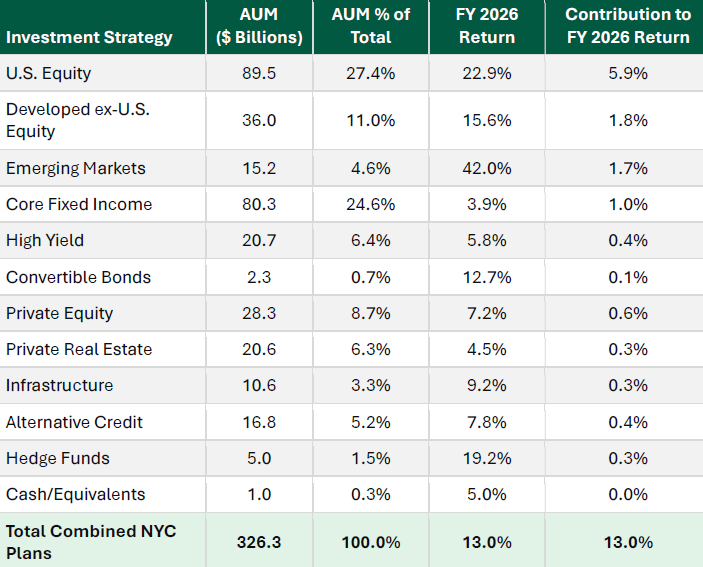
The Systems’ private markets investment returns supported their long-term investment strategy, providing diversification, downside protection and long-term value creation. Hedge Funds delivered a record program return of 19.2%, while Infrastructure and Alternative Credit also generated strong returns of 9.2% and 7.8%, respectively. Real Estate also saw stronger returns this year due to the strategic shift toward multifamily and industrial properties, and a reduction in office exposure.

“This past year’s performance reflects our commitment to deliver for hundreds of thousands of members and beneficiaries counting on us to safeguard the retirement assets that they have worked tirelessly to earn. I am grateful for the leadership of Comptroller Levine, and the commitment of staff within the Bureau of Asset Management, and our fruitful partnership with our asset managers, trustees and investment consultants that made this possible,” said Chief Investment Officer Monte Tarbox.

Assets Under Management, Return Net of Fees, and Contribution to Return

Review this report on the audited investment returns for the fiscal year ending June 30, 2026, at https://comptroller.nyc.gov/reports/new-york-city-pension-funds-returns-for-fiscal-year-2026 for market reflections and a detailed review on overall performance and individual asset classes.

About the New York City Retirement Systems

The New York City retirement systems comprise the City’s five public pension funds (the New York City Teachers’ Retirement System, Employees’ Retirement System, Police Pension Fund, Fire Pension Fund, and Board of Education Retirement System), and are collectively the third largest public pension system in the nation, valued at approximately $326.3 billion in assets under management as of June 30, 2026.

About the Role of the Comptroller of the City of New York

New York City Comptroller Mark Levine serves as custodian, delegated investment advisor, and a trustee for New York City’s five public retirement systems (the “Systems”). Through the work of the Bureau of Asset Management (“BAM”), the Comptroller partners with the Systems’ trustees and their consultants to prudently invest over $325 billion on behalf of more than 750,000 current and retired public servants, ensuring the long-term retirement security of the City’s dedicated workforce.

In addition to Comptroller Levine, trustees of the New York City retirement systems are as follows:

Teachers’ Retirement System of the City of New York (TRS): Mayor Zohran Mamdani’s appointee Ahmer Qadeer, Director and Chief Pension Administrator, Mayor’s Office of Pensions and Investments; Gregory Faulkner, Chair, New York City Public Schools Panel for Educational Policy; and Thomas Brown (Board Chair), Victoria Lee, and Christina McGrath, all of the United Federation of Teachers.

New York City Employees’ Retirement System (NYCERS): Mayor Zohran Mamdani’s representative Ahmer Qadeer, Director and Chief Pension Administrator, Mayor’s Office of Pensions and Investments (Board Chair); New York City Public Advocate Jumaane Williams; Borough Presidents: Donovan Richards Jr. (Queens), Antonio Reynoso (Brooklyn), Vanessa L. Gibson (Bronx), Brad Hoylman-Sigal (Manhattan), and Vito Fossella (Staten Island); Henry Garrido, Executive Director, District Council 37, AFSCME; John Chiarello, President, Transport Workers Union Local 100; and Gregory Floyd, President, International Brotherhood of Teamsters, Local 237.

New York City Police Pension Fund (Police): Mayor Zohran Mamdani’s representative Ahmer Qadeer, Director and Chief Pension Administrator, Mayor’s Office of Pensions and Investments; New York City Police Commissioner Jessica Tisch (Board Chair); New York City Finance Commissioner Richard Lee; Patrick Hendry, President, Albert Alcierno, First Vice President, Arthur Egner, Second Vice President and Michael Freeman, Chair, all of the NYC Police Benevolent Association; Chris Monahan, President, Captains Endowment Association; Louis Turco, President, Lieutenants Benevolent Association; Vincent Vallelong, President, Sergeants Benevolent Association; and Scott Munro, President, Detectives Endowment Association.

New York City Fire Pension Fund (Fire): Mayor Zohran Mamdani’s representative Ahmer Qadeer, Director and Chief Pension Administrator, Mayor’s Office of Pensions and Investments; New York City Fire Commissioner Lillian Bonsignore (Board Chair); New York City Finance Commissioner Richard Lee;  Robert Eustace, President, Dennis Tveter, Vice President, Chris Viola, Treasurer, and Robert Unger, Chair, Uniformed Firefighters Association of Greater New York; Sean Michael, Chief’s Rep., Liam Guilfoyle, Captain’s Rep., and Joseph Camastro, Lieutenants’ Rep., all of the Uniformed Fire Officers Association; and John Young, President, Marine Engineers Association.

Board of Education Retirement System of the City of New York (BERS): Members of the New York City Public Schools Panel for Educational Policy, including: Borough President Appointees Costa Constantinides (Queens), Camille Casaretti (Brooklyn), Dr. Jonathan Collins (Manhattan), Rima Izquierdo (Bronx), and Aaron Bogad (Staten Island); Elected CEC Members Adriana Alecia (Queens), Faraji Hannah-Jones (Brooklyn), Naveed Hasan (Manhattan), and Rev. Laticia Thompson (Bronx); Mayoral appointees Karla Cordero, Marjorie Dienstag, Amy Fair, Dr. Maddy Fox, Kristin Jefferson, Tariq Khan, Lucas Koehler, Primo Lasana, Mehrain Mahdi, Alan Ong, Courtney Rajwani, Raysa Rodriguez, and Crystal Vera-Montalvo; New York City Public Schools Chancellor Kamar Samuels, represented by Karine Apollon (Board Co-Chair); as well as two elected employee members: Donald Nesbit, District Council 37, Local 372 (Board Co-Chair) and Frank Sirabella, IUOE Local 891.

BRONX MAN SENTENCED TO TWO YEARS IN JAIL FOR ANIMAL CRUELTY IN DEATH OF CAT


Defendant Posted Photos of Dead Feline on Social Media

Bronx District Attorney Darcel D. Clark announced that a Bronx man was sentenced to two years in jail for Aggravated Cruelty to Animals in connection with the death of a cat he had brought into his home. 

District Attorney Clark said, “This defendant committed a crime that shocked and outraged the community. For reasons known only to him he tortured and killed a cat and then posted disturbing images of the dead animal on social media. He has been held accountable for what he did.” 

District Attorney Clark said the defendant, David Mosley, 26, of the Bronx, was sentenced today to two years in jail by Bronx Supreme Court Justice Laurence Busching. Mosley pleaded guilty to Aggravated Cruelty to Animals on July 10 and was immediately remanded on that day. Today was the formal sentencing. The defendant will get credit for time served since July 10. With his plea he is prohibited from owning or harboring animals for 10 years.

According to the investigation, on or about October 11, 2025, the defendant posted a photo on Instagram of himself and a live cat. On or about October 22, 2025, a photo of a cat lying motionless in a pool of what appeared to be blood was posted on Instagram. Detectives searched Mosley’s apartment on October 29, 2025, and observed dried biological material on the floor that was later determined by the ASPCA to be feline blood. With the assistance of the ASPCA it was determined that the live cat pictured with Mosley in the October 11th social media post was the same animal pictured in the October 22nd Instagram post. Detectives also obtained surveillance video from Mosley’s apartment building that shows him carrying the cat into his apartment on October 9th while it was still alive. When questioned by detectives, Mosley said he had found the cat after it died.

District Attorney Clark thanked Sergeant Timothy Cecchine and Detective Jean Seder of the NYPD Animal Cruelty Investigation Squad for their work in the investigation. District Attorney Clark also thanked ASPCA forensic veterinarian Dr. Laura Niestat for her assistance in the investigation. 

Wednesday, August 12, 2026

New York City Council Announces Investigation of Deceptive and Predatory Marketing Practices by Prediction Market Platforms


Investigation and planned hearing are aimed at determining need to strengthen consumer protections, safeguard minors, and address risks of marketing to those with addictive tendencies

Speaker Julie Menin sent letters to Kalshi, Polymarket, Coinbase, and Gemini Titan notifying platforms and requesting information about practices

New York City Council Speaker Julie Menin today announced an investigation into major prediction market platforms. The inquiry is focused on their marketing and advertising practices in the city, including potentially false, deceptive, or abusive marketing tactics, with particular concern for marketing directed towards young people. Speaker Menin notified four platforms — Kalshi, Polymarket, Coinbase, and Gemini Titan — of the investigation through official letters requesting information about their respective marketing practices that reach New Yorkers.

For months, the Council has been looking into issues related to allegations of predatory marketing practices associated with the prediction market industry, which has grown rapidly in New York City. Some of these practices raise serious concerns. Ultimately, the Council aims to determine whether additional consumer protection legislation, enforcement, public education campaigns, health measures, and funding are necessary to protect New York City consumers from abusive marketing.

“As a mother of four, I know firsthand the fears that come with raising kids in a world where predatory industries are constantly finding new ways to target them,” said Speaker Julie Menin. “Prediction markets aggressively entice consumers to bet and wager on sports, politics, culture, weather, and pretty much anything. We refuse to let New Yorkers, especially our young people, become collateral damage. As a regulatory attorney and the former Commissioner of Consumer Affairs, I take consumer protection extremely seriously. I intend to harness the full power of the Council to protect New Yorkers from deceptive and predatory marketing practices by prediction market platforms.”

As Commissioner of the Department of Consumer Affairs, Speaker Menin oversaw trailblazing investigations into predatory industries — including for-profit colleges, fraudulent auto loans, illegal and unlicensed secondhand gun sellers, and debt collectors — some of them for questionable and deceptive marketing practices.

“Good government requires us to ask questions, examine the facts, and make informed decisions, particularly as new and emerging industries reach more New Yorkers,” said Deputy Speaker Dr. Nantasha Williams. “We also have to recognize the potential harms associated with these platforms, particularly when it comes to young people, compulsive wagering, and how these products are marketed to consumers. As the Council begins this inquiry, it is important that we hear from all stakeholders, deepen our knowledge of this emerging market, examine the practices and potential impacts at issue, and allow that information to guide our work. New Yorkers deserve a process that takes these concerns seriously, follows the facts, and allows us to determine the appropriate path forward.”

As part of its investigation, the Council will examine allegations that Polymarket used or allowed social media influencers to entice young adults to bet on “event contracts” through false and deceptive marketing. These reported tactics include undisclosed influencer marketing, videos depicting non-existent trades on websites designed to appear similar to Polymarket, fictitious depiction of profitable wagers that actually would have generated losses, and the promotion of insider trading.

Understanding whether such marketing practices are prevalent within the prediction market industry is critical to determining what legislation, regulations, and programs are needed. The fact that key marketing restrictions and consumer protections that govern casinos and online sports betting do not currently restrain prediction markets adds to the necessity and urgency of the Council’s inquiry.