Monday, January 19, 2026

La Central’s Two-Building, 420-Unit Second Phase Takes Shape in Melrose, The Bronx


Rendering of La Central. Courtesy of Hudson Companies

Construction is progressing on 625 and 671 Brook Avenue, the final two residential buildings in the La Central complex in Melrose, The Bronx. Designed by MHG Architects and FXCollaborative, the 13- and 25-story structures will yield 420 affordable homes, including 63 supportive units for formerly homeless individuals. The buildings will also feature a 13,000-square foot community facility space, 1,500 square feet of ground-floor retail, and 7,000 square feet of landscaped gardens designed by Future Green Studios. The project is being developed by a joint venture between Hudson Companies, BRP Companies, ELH-TKC, Breaking Ground, Comunilife, and J.P. Morgan, with the city contributing more than $137 million through the Department of Housing Preservation and Development.

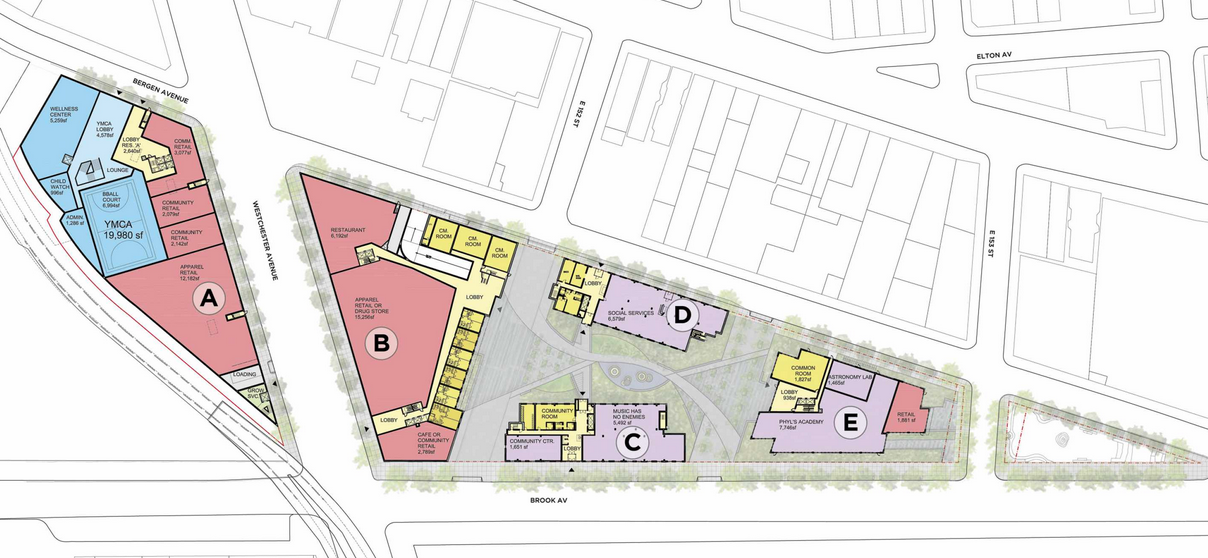
625 Brook Avenue is known as Building C, and 671 Brook Avenue is known as Building E, as highlighted in the diagram below. The properties are bounded by Brook, Bergen, and Westchester Avenues on a block containing a completed residential building from the first phase of La Central.

Site plan for La Central, courtesy of FXCollaborative.

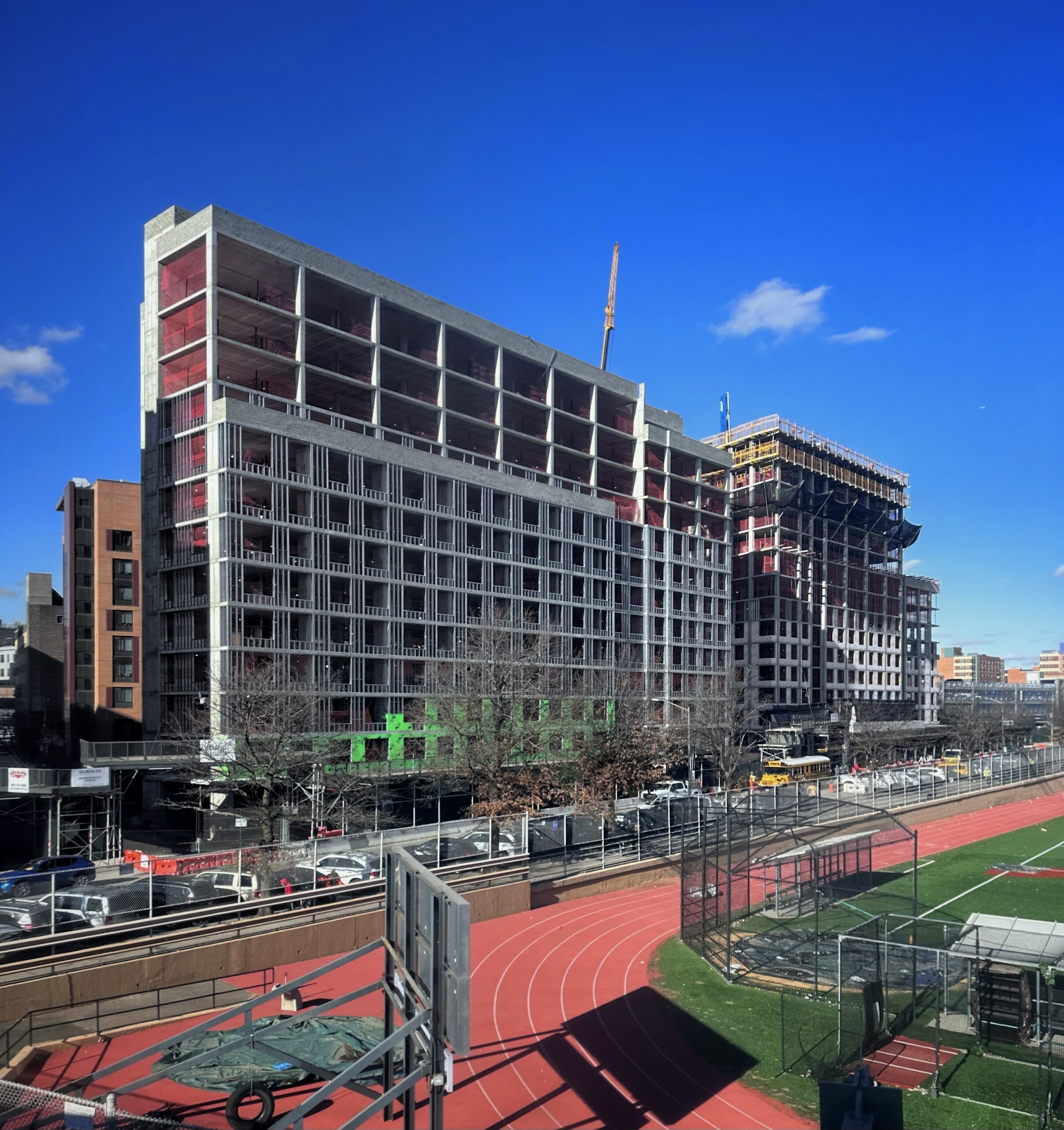
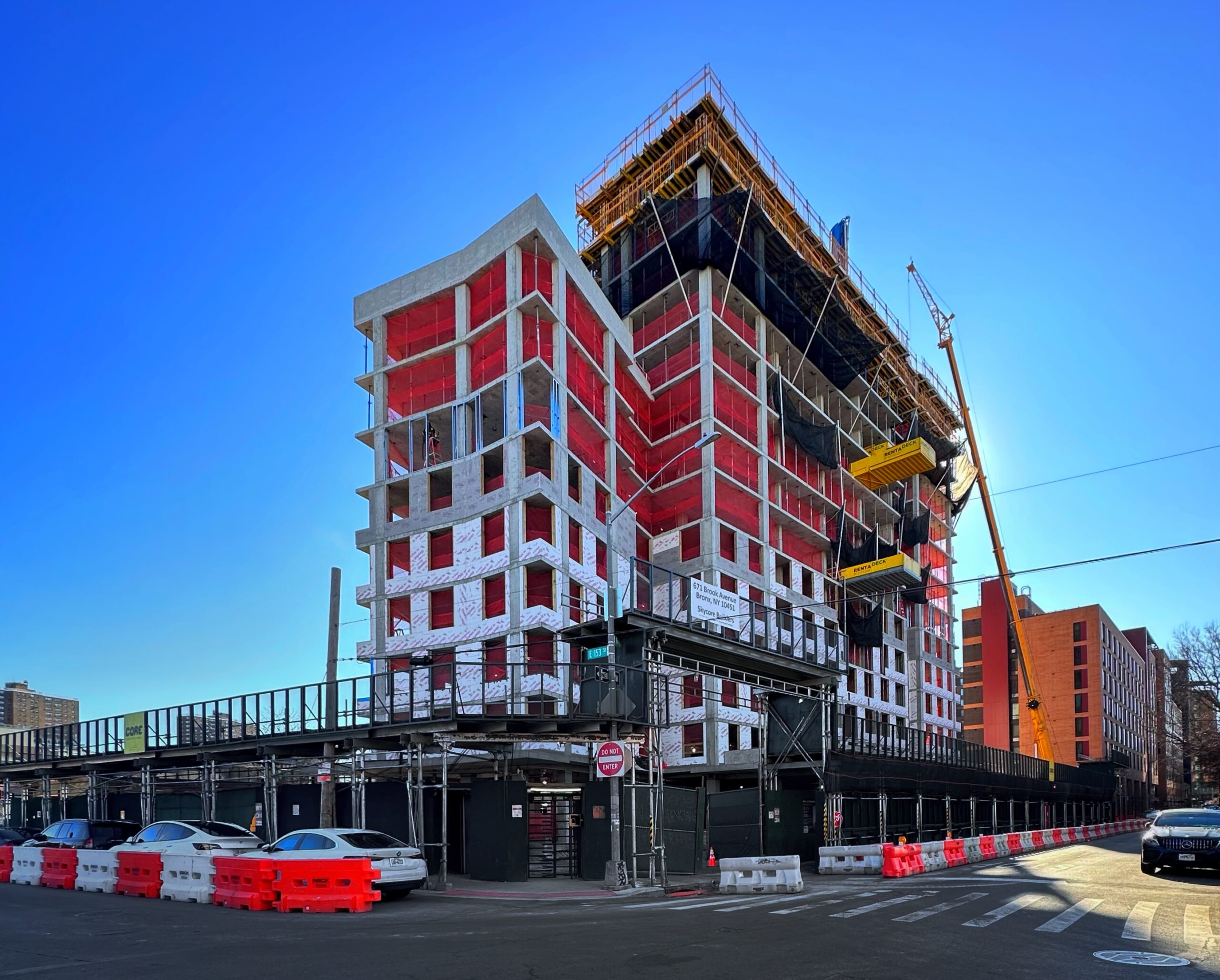
The shorter building at 625 Brook Avenue is topped out and in the process of being framed with metal studs and insulation boards. Framing work is also progressing concurrently on the rising superstructure of the taller 671 Brook Avenue, which has surpassed the halfway mark. A telescopic boom crane is being used to hoist materials into place across the site, while trucks deliver cement and other building supplies on the eastern side of the complex.

The site was formerly vacant before construction broke ground last summer.

625 Brook Avenue. Photo by Michel Young.

671 Brook Avenue. Photo by Michel Young.

Rendering of La Central. Courtesy of Hudson Companies

Rendering of La Central. Courtesy of Hudson Companies

Aerial rendering of La Central, courtesy of FXCollaborative.

The affordable units in this phase will be reserved for households earning between 30 and 80 percent of the area median income (AMI), with a breakdown of 114 units for extremely low-income households; 106 for very low-income; 198 for low-income; and two units for building superintendents. Building E at 671 Brook Avenue will also house a rooftop telescope managed by Bronx High School of Science.

Funding for this last phase of La Central include tax-exempt bonds, low-income housing tax credits, Brownfield Tax Credits, NYSERDA grants, and capital allocations from the New York City Council. Red Stone Equity Partners is serving as tax credit syndicator, and J.P. Morgan is providing credit enhancement.

The entire La Central master plan will introduce more than 1,000 affordable homes in structures engineered to LEED and NYSERDA standards.

The nearest subways from the site are the 2 and 5 trains at the 3rd Avenue–149th Street station to the southwest.

Building C at 625 Brook Avenue is slated for completion in December 2027, and Building E at 671 Brook Avenue is aiming for completion in the first quarter of 2028, as noted on site.

Permits Filed for 3545 Edson Avenue in Edenwald, The Bronx


Permits have been filed for a four-story residential building at 3545 Edson Avenue in Edenwald, The Bronx. Located between Needham Avenue and Boston Road, the corner lot is near the Baychester Avenue subway station, served by the 5 train. Israel Tishler of Revamp NYC is listed as the owner behind the applications.

The proposed 42-foot-tall development will yield 8,890 square feet designated for residential space. The building will have 15 residences, most likely rentals based on the average unit scope of 592 square feet. The concrete-based structure will not have any accessory parking.

Ariel Golshan of AG Engineering PLLC is listed as the architect of record.

Demolition permits have not been filed yet. An estimated completion date has not been announced.

Bronx Borough President Vanessa L. Gibson - JOIN ME: 2026 Inauguration Ceremony


CLICK HERE TO RSVP


Sunday, January 18, 2026

False Claims Act Settlements and Judgments Exceed $6.8B in Fiscal Year 2025


Settlements and judgments under the False Claims Act exceeded $6.8 billion in the fiscal year ending Sept. 30, 2025, Deputy Attorney General Todd Blanche and Assistant Attorney General Brett A. Shumate, head of the Justice Department’s Civil Division, announced today. That amount is the highest in a single year in the history of the False Claims Act. This year, whistleblowers filed 1,297 qui tam lawsuits, the highest number in a single year, and the government opened 401 investigations, including matters announced as Administration policy objectives. Settlements and judgments since 1986, when Congress substantially strengthened the civil False Claims Act, now total more than $85 billion.

“Stopping rampant fraud is a top priority, and this record-breaking year proves the False Claims Act remains one of the government’s most powerful weapons against fraud,” said Deputy Attorney General Todd Blanche. “We will continue to aggressively deploy it to protect taxpayer dollars and hold all fraudsters accountable.”

“The achievements announced today reflect exemplary work by the Department’s dedicated employees to investigate and litigate cases involving fraud against the government and to ensure that America’s taxpayer dollars are used for their intended purpose,” said Assistant Attorney General Brett A. Shumate of the Justice Department’s Civil Division. “The False Claims Act and its whistleblower provisions are crucial tools for ensuring that public funds are spent properly and in the public interest.”

“The False Claims Act is at its best when it protects taxpayers and the Americans who rely on government programs,” said Deputy Assistant Attorney General Brenna Jenny of the Justice Department’s Civil Division. “The Department’s False Claims Act enforcement is guided by a simple principle: the statute is a powerful tool, and it should be used responsibly. The record-breaking recoveries announced today show our commitment to holding bad actors accountable, safeguarding taxpayer dollars, and protecting vulnerable populations.”

The False Claims Act imposes treble damages and penalties on those who knowingly and falsely claim money from the United States or knowingly fail to pay money owed to the United States. The False Claims Act thus safeguards government programs and operations that provide access to medical care, support our military and first responders, protect American businesses and workers, help build and repair infrastructure, offer disaster and other emergency relief, and provide many other critical services and benefits. The resolutions in fiscal year 2025 also reflect the Department’s focus on key enforcement areas, including combating fraud in the federal health care system and in the government’s procurement, loan, and grant programs and redressing the improper avoidance of tariffs and customs duties that are owed.

Health care fraud remained a leading source of False Claims Act settlements and judgments. Of the more than $6.8 billion in False Claims Act settlements and judgments reported by the Department of Justice this past fiscal year, over $5.7 billion related to matters that involved the health care industry. These recoveries restore funds to federal programs such as Medicare, Medicaid, and TRICARE, the health care program for service members and their families. But just as important, in many cases, enforcement of the False Claims Act also protects patients from medically unnecessary or potentially harmful conduct. As in years past, the Act was used to pursue matters involving a wide array of health care providers, goods, and services. Most notably, the Department continued and expanded its success in three major areas: Managed Care, Prescription Drugs, and Medically Unnecessary Care. The amounts included in the $5.7 billion reflect recoveries arising only from federal losses, but in many of these cases, the department was instrumental in recovering additional amounts for state Medicaid programs.  

The Department also continued its pursuit of fraud matters involving the purchase of goods and services by the government. Fraud on the military squanders government funds, can deprive servicemembers of critical resources and potentially put them at risk, and creates potential national security risks. The Department also continued to advance cases holding government contractors and grantees accountable when they knowingly violate applicable cybersecurity requirements.  It likewise continued to invest resources in recovering hundreds of millions of dollars lost to fraud in pandemic programs.

Finally, the Department directed resources to combatting fraud that evades tariffs and customs duties, launching a cross-agency Trade Fraud Task Force to enhance efforts to prevent trade fraud that deprives the government of vital revenues, threatens critical domestic industries, undermines consumer confidence, and weakens national security. These matters focus on those who attempt to misrepresent the type of goods imported or an item’s country of origin or disguise items to evade duties.

In furtherance of its efforts to recover funds for the public fisc, the Department remained committed to incentivizing and rewarding entities and individuals that self-disclose misconduct, demonstrably cooperate in the course of an investigation, and take effective remedial measures. Several settlements over the last year acknowledged such cooperative measures and reflected credits afforded to the defendants in the form of reduced penalties or damage multiples in connection with the resolution, including several of the matters discussed in the attached Fact Sheet. These cooperative measures can include self-disclosures, assistance with the determination of government losses, disclosures of internal investigations and facts not known to the government, and remedial measures such as implementing compliance program enhancements or terminating or separating culpable employees.

In 1986, through the leadership of Senator Charles Grassley, Congress strengthened the False Claims Act by increasing incentives for whistleblowers to file lawsuits alleging false claims on behalf of the government. These whistleblower, or qui tam, actions comprise a significant percentage of the False Claims Act cases that are filed. Qui tam cases may be pursued by the government or the whistleblower, and this past year, significant recoveries were obtained by both. When a qui tam action is successful, the whistleblower, also known as the relator, typically receives a portion of the recovery ranging between 15% and 30%. The 1,297 qui tam suits filed in fiscal year 2025 breaks the prior record set in 2024 of 980 such cases. This past year, the Justice Department reported settlements and judgments exceeding $5.3 billion in these and earlier-filed qui tam suits.

On behalf of the Civil Division, Deputy Assistant Attorney General Jenny expressed appreciation for the many public servants over the past year who supported the department’s enforcement efforts. “The results of the past fiscal year are the product of a talented team of civil servants who pursue righteous FCA cases and return funds to American taxpayers.  These hard-working individuals tackle the most complex civil fraud matters and serve at offices across the country, including the Fraud Section of the Civil Division, the U.S. Attorneys’ Offices, the agency Offices of Inspector General and Offices of General Counsel, and many other federal and state agencies that contribute to this important work.”

Except where indicated, the government’s claims in the matters described in the attached Fact Sheet are allegations only and there has been no determination of liability. The numbers contained in this press release may differ slightly from the original press releases due to accrued interest.

Governor Hochul Updates New Yorkers on State Preparations Ahead of Impending Lake Effect Snow

snow plows

Snowfall Sunday Brings Accumulations of up to Five Inches in Areas Across the Mid-Hudson, New York City and Long Island Regions

Lake Effect Snow to Impact Areas off of Lake Erie and Lake Ontario Today through at least Tuesday

Areas off Lake Ontario Could See Two to Three Feet; Areas off Lake Erie in the Southern Buffalo Metro Area Could See up to One and a Half Feet

Heavy Snow Has the Potential to Impact Morning and Evening Commutes both Monday and Tuesday; Wind Gusts of up to 50 Miles per Hour will Cause Blowing Snow, Reducing Visibility on Roadways

Severe Cold to Move in Monday through Wednesday and Could Amplify Impacts of any Power Outages

New Yorkers Can Sign Up for Weather and Emergency Alerts by Texting 333111

Governor Kathy Hochul today updated New Yorkers on the State’s preparations ahead of lake effect snow set to impact areas east of Lake Erie and Lake Ontario beginning today and continuing through at least Tuesday night. Following a system that will bring up to five inches of snow to the Mid-Hudson, New York City and Long Island regions on Sunday, Monday is set to bring snow that will be heavy at times with up to three feet possible for areas off Lake Ontario, including the Tug Hill Plateau, and up to one and a half feet for areas south of Buffalo, such as the Chautauqua Ridge. The combination of heavy snow and strong winds will create dangerous travel conditions, especially during the Monday and Tuesday commutes. Power outages are possible and temperatures below zero Monday night through Wednesday could amplify the impacts of any outages.

“New York is prepared, and we are urging everyone in the affected regions to take this storm seriously,” Governor Hochul said. “Heavy lake effect snow, dangerous winds, and bitter cold will make travel hazardous and could lead to power outages. State agencies are mobilized and ready, but the safest choice is to limit travel when possible, make sure you have supplies on hand, check on vulnerable neighbors, and stay informed as conditions continue to change through Tuesday. If you must be out, leave yourself extra travel time and use caution.”

Areas off Lake Ontario could see widespread totals of one to six inches of snow on Monday, with localized totals of up to eight inches. On Tuesday, widespread totals of up to 10 inches are possible, with potential for localized totals of up to two feet. At times, peak snowfall rates have the potential to be more than four inches an hour. Peak totals are most likely for northern Oswego, western Lewis and southern Jefferson counties.

At the same time, areas off Lake Erie could see totals of one to four inches of snow on Monday, with isolated totals of eight inches possible. Tuesday, widespread totals to up to six inches are forecasted, with localized totals of 10 inches possible. Snowfall rates could reach rates of two inches per hour at times. Peak totals are most likely for southern Erie, northern Chautauqua and northern Cattaraugus Counties.

Winds off both Lake Erie and Lake Ontario will combine with snowfall to create difficult travel conditions with blowing snow and reduced visibility. Below freezing temperatures will be very dangerous for motorists who may become stranded. Drivers should avoid any unnecessary travel and allow themselves extra time between destinations and ensure their vehicles are packed with supplies like blankets and water.

In addition to preparing for snow and wind, New Yorkers should also prepare to protect against the dangers that can result from colder weather and winter activities. Under state regulation, a Code Blue is automatically in effect whenever the temperature and wind chill equal less than 32 degrees. Local social services districts are legally required to take necessary steps to ensure those experiencing homelessness have access to shelter and that shelter hours are extended. New Yorkers also should check out these cold weather tips from the Department of Healthadditional tips for preventing frostbite and hypothermiainformation on Carbon Monoxide poisoninginformation on the proper use of generators; and safe winter driving tips.

The New York State Department of Labor advises workers and employers to engage in extreme cold weather best practices such as:

  • Limit outdoor work, provide frequent breaks in warm areas and schedule outdoor work during the warmest times of the day.
  • Ensure access to clean drinking water.
  • Stay hydrated with warm beverages and avoid drinking caffeine.
  • Wear proper PPE, including at least three layers of clothing, gloves or mittens, thick socks, insulated footwear and a hat, hood or hard hat liner.

View more information on best practices for working in cold weather.

Winter Storm Warnings and Winter Weather Advisories have been issued, and New Yorkers should closely monitor their local forecasts and look for updates issued by the National Weather Service. For a complete listing of weather alerts, visit the National Weather Service website.

New Yorkers should also ensure that government emergency alerts are enabled on their mobile phones. They should also sign up for real-time weather and emergency alerts that will be texted to their phones by texting their county or borough name to 333111.

Winter Driving Safety Tips

  • Monitor the forecast for your local area and areas you may be travelling to.
  • Avoid unnecessary travel.
  • If you must travel, make sure your car is stocked with survival gear like blankets, a shovel, flashlight and extra batteries, extra warm clothing, set of tire chains, battery booster cables, quick energy foods and brightly colored cloth to use as a distress flag.
  • If you have a cellphone or other communications device such as a two-way radio available for your use, keep the battery charged and keep it with you whenever traveling. If you should become stranded, you will be able to call for help, advising rescuers of your location.
  • The leading cause of death and injuries during winter storms is transportation accidents. Before getting behind the wheel, make sure that your vehicle is clear of ice and snow; good vision is key to good driving. Plan your stops and keep more distance between cars. Be extra alert and remember that snowdrifts can hide smaller children. Always match your speed to the road and weather conditions.
  • It is important for motorists on all roads to note that snowplows travel at speeds up to 35 mph, which in many cases is lower than the posted speed limit.
  • Oftentimes on interstate highways, snowplows will operate side by side, to safely clear several lanes at one time.
  • Motorists and pedestrians should also keep in mind that snowplow drivers have limited lines of sight, and the size and weight of snowplows can make it very difficult to maneuver and stop quickly. Snow blowing from behind the plow can severely reduce visibility or cause whiteout conditions.
  • Motorists should not attempt to pass snowplows or follow too closely. The safest place for motorists to drive is well behind the snowplows where the roadway is clear and salted. Never attempt to pass a snowplow while it's operating.

Power Outage Safety Tips

  • Do not go near or touch fallen or sagging power lines: treat all wires as live and dangerous. Keep children and pets away from fallen electric wires. Never touch any lines or any items that are in contact with lines.
  • Check with your utility to determine area repair schedules.
  • Turn off or unplug lights and appliances to prevent a circuit overload when service is restored; leave one light on to indicate when power has been restored.
  • If heat goes out during a storm, keep warm by closing off rooms you do not need.

To Report an Electric Outage, Call:

Central Hudson: Electric: 800-527-2714 or Gas: 800-942-8274

Con Ed: Electric: 800-752-6633 or Gas: 800-752-6633

Corning Gas: 800-834-2134

Liberty Utilities (St. Lawrence Gas) Corp.: 800-673- 3301

National Fuel Gas: 1-800-444-3130

National Grid:

  • Electric: 800-867-5222
  • Long Island (gas): 1-800-490-0045
  • Metro NYC (gas): 1-718-643-4050
  • Upstate (gas): 1-800-892-2345

NYSEG: Electric: 800-572-1131 or Gas: 800-572-1121

O&R: Electric: 877-434-4100 or Gas: 800-533-5325

PSEG-LI: 800-490-0075

RG&E: Electric: 800-743-1701 or Gas: 800-743-1702

For more safety tips, go to www.dhses.ny.gov/safety. 

GrowNYC Education: Happy 2026! Indoor winter gardening, workshops, grants, & more!


GrowNYC Banner

GrowNYC Education
winter

Snow covered garden

Jan26

Indoor Winter Gardening

microgreens

Mixed radish microgreens
  • Are you longing to get your hands in the soil and grow some veggies but the cold is keeping you from doing so? Don’t fret, you can grow some of the fastest growing vegetables at your windowsill!

  • Introducing the microgreens: the easiest veggie you can grow indoors within a few weeks, all year round! As long as your space is warm and has plenty of light, no outdoor garden is necessary.

  • What ARE microgreens? Microgreens are any vegetable greens harvested just after the cotyledon, or seed leaves, and one set of ‘true leaves’ have developed. They taste like concentrated, more intensely flavored versions of their fully-grown counterparts, and they are packed with nutrients and antioxidants. Some of the most common varieties include radish, broccoli, cress, arugula, and pea shoots. You can add them to your salads and sandwiches or dress up your dish by topping them off with your favorite microgreens.

  • Follow our step-by-step guide Grow Microgreens on Your Windowsill and ease that yearning to garden outside!

School Gardening Through a Teacher Team Lens (Virtual Workshop Series)

Katrina & Justine

Katrina Duncan (right) & Justine Shishkoff (left) from PS 135Q, The Bellaire School.
  • Tuesdays, January 27, February 24, and March 24

  • 4:30 to 5:30 pm EST

Join GrowNYC for 3 virtual gardening workshops with PS 135 The Bellaire School's teachers, Katrina Duncan and Justine Shishkoff. In this 3-part series, explore creating and maintaining a school garden. Workshops include presentations and audience Q&A.

  • Jan 27 - Workshop 1: Planting the Seeds - Vision & Foundations of a School Garden: Get ready to get your hands and minds dirty in this interactive workshop where participants will explore how to plan, design, and bring to life a meaningful school garden. You’ll collaborate, brainstorm, and start building a vision for a garden that grows learning, community, and joy.

  • Feb 24 - Workshop 2: Hands-On Garden Skills & Curriculum Integration: Discover how your school garden can become one of your most powerful teaching tools. In this workshop, educators will dig into real gardening skills while learning creative, standards-aligned ways to connect planting, growing, and harvesting to science, math, literacy, and healthy living.

  • Mar 24 - Workshop 3: Sustainability, Stewardship & Community Engagement: Learn how to inspire students to care for their world by turning real-world projects and community partnerships into powerful lessons in sustainability. This workshop gives educators practical ideas to help students take ownership, build leadership skills, and become active sustainability stewards.

rsvp

Create a Pollinator Habitat in Your School Garden (In-Person Workshop)

Pollinator Workshop

Anise Hyssop for the bumblebees
  • Wednesday, February 11

  • 4:00 to 5:30 pm EST

  • Suite 3300, 100 Gold St, New York, NY 10038

Pollinators are essential to any garden community. Learn how to create habitats that support native bees, butterflies, moths, and other pollinators in school gardens, community spaces, and even window boxes. Lesson plans and activities will also be shared to help teach students about pollinators and their habitats.

Join GrowNYC School Gardens and Edible Schoolyard NYC for our in-person workshop where you’ll learn all about the variety of pollinators in NYC, the native plants they love, and how to create a pollinator habitat for your urban garden space.

rsvp

GrowNYC School Garden Drop-In Hour (Virtual Event)

drop-in hour

Students from PS 3 Charrette School
  • Thursday, February 12

  • 3:30 - 4:30 pm EST

Calling NYC DOE K-12 public schools! Do you want to create or re-start a school garden or outdoor classroom at your school? Did your school receive the Fall 2025 NYCPS Office of Energy & Sustainability annual grant and need guidance on spending it down? Join this drop-in hour where you can get support from the GrowNYC School Gardens team.

We can help you create a vision, plan, map, and budget for your school garden/outdoor learning project, and trouble-shoot challenges. Come, Drop-In, and Ask your questions!

rsvp


Spring Preparation for School Gardens (Virtual Workshop)

Spring planning

Green Team member of PS94X
  • Wednesday, March 11

  • 3:30 to 4:45pm EST

Spring is almost here! As the weather warms, spring is a crucial time for school gardens. Thoughtful planning ensures your school garden community can learn valuable lessons, build essential skills, and enjoy the fruits of their labor before the school year ends.

Join the GrowNYC School Gardens Team during this virtual workshop as we break down the planning stages for early, mid, and late spring and to learn best practices for essential gardening tasks, including garden bed preparation, tool care, and planting schedules. This workshop will help prepare school garden communities for a successful spring growing season. Participants will also learn how to plan community events and cultivate experiences for students.

rsvp

Grant Opportunities