
Organization Shipped Over 15,000 Pounds of Marijuana from California to New York's Capital Region and Laundered Millions of Dollars in Drug Proceeds
Dwight A. Singletary II, aka “Nutt” and “Mike Jones,” age 44, of Fresno, California and Troy, New York, pled guilty August 25, 2026, to leading a nationwide marijuana and THC trafficking organization that shipped thousands of kilograms of marijuana from Fresno to locations throughout the United States, including the Capital Region. Singletary is the 25th and final defendant to plead guilty in the case.
Starting in 2016, Singletary and other members of the organization shipped marijuana and THC from a shipping store in Fresno, Fast Pack & Ship, to recipients throughout the United States, including the Capital Region, New York City, and other parts of New York, Alabama, Connecticut, Delaware, Florida, Georgia, Louisiana, Maryland, Massachusetts, Missouri, Nevada, New Jersey, North Carolina, Ohio, Oklahoma, South Carolina, Tennessee, Texas, and Virginia. Fast Pack & Ship was initially owned by Sammy Olague, who sold the store to Nehemiah Fane, aka “Neil,” in June 2018. Singletary helped finance the purchase, and Fane ran the store with James Tyrell Daniels, aka “Red” and “Ghost,” and Ruby Ledesma before transferring it to the mother of Singletary’s children, McKenzie Merrialice Coles, aka “Kenzie,” in April 2020. Coles, who is originally from Troy but lived with Singletary in Fresno, operated Fast Pack & Ship through M.M.M.C. Management, Inc. Singletary, Coles, Fane, Daniels, Olague, Ledesma and other members of the organization all shipped marijuana from Fast Pack & Ship.
The packages of marijuana, which were shipped through UPS and FedEx, reflected the names of fake shippers, and the marijuana was concealed in dog food containers and luggage. To avoid detection, the packages of marijuana were often sealed with eBay packing tape. Between April 2017 and June 2022, approximately 1,292 packages containing 7,068 kilograms, or 15,582 pounds, of marijuana were shipped from Fast Pack & Ship to the Capital Region alone.
“This guilty plea marks the final defendant held accountable in a sophisticated, nationwide drug trafficking organization that moved more than 15,000 pounds of marijuana from California into the Capital Region and communities across the country,” stated DEA New York Enforcement Division Special Agent in Charge Farhana Islam. “For years, this organization attempted to conceal its criminal enterprise by disguising drug shipments in dog food containers and luggage, using our nation’s commercial shipping system to move thousands of pounds of marijuana, and laundering millions of dollars in drug proceeds through cash couriers, financial transactions and real estate. The DEA and our law enforcement partners have and will always continue to relentlessly pursuit drug trafficking organizations at every level; from its leadership and suppliers to its distributors and those responsible for laundering its profits.”
“With this final guilty plea, my office has now brought 25 defendants to justice for their roles in this criminal enterprise,” said First Assistant U.S. Attorney John A. Sarcone III. “These individuals operated a large-scale illegal marijuana and THC trafficking scheme, moving their illicit product across the country and into the Capital Region. As if flooding the community with unregulated, illegal drugs weren’t harmful enough, they also sought to launder millions of dollars in illegal profits. Thanks to the collaboration of our law enforcement partners across the country, their scheme was disrupted, and justice has been delivered to all 25 defendants.”
ATF New York Special Agent in Charge Bryan DiGirolamo said, “This guilty plea closes the chapter on a sprawling criminal organization that moved thousands of kilograms of marijuana and THC across the country and into communities throughout New York’s Capital Region. This network relied on concealed shipments, knock spots and, in some instances, firearms to facilitate and protect its illegal drug trafficking activities. Holding the 25th and final defendant accountable reflects years of determined investigative work and the strength of the partnerships that brought this organization down. ATF NY Albany is proud to have worked alongside HSI, DEA, the Troy Police Department and the U.S. Attorney’s Office for the Northern District of New York to dismantle this network and hold those responsible accountable.”“This investigation is a strong example of the importance of law enforcement agencies working together to address complex criminal activity. Our task force officer’s involvement reflects this department’s commitment to supporting our federal law enforcement partners. We are proud of the work our detective contributed to this investigation. Strong partnerships and interagency cooperation are critical to keeping our communities safe and holding those responsible for criminal activity accountable,” said Troy Chief of Police Daniel DeWolf
HSI Buffalo Acting Special Agent in Charge Anthony Patrone said, “Dwight Singletary led a coast-to-coast marijuana and THC trafficking organization that, for years, shipped more than 15,000 pounds of marijuana to the Capital Region alone using fake shipper names, dog food containers, luggage, and other methods designed to hide the crime. This investigation exposed the full scope of the operation, from packaging and shipment in Fresno, to street-level ‘knock spot’ sales in New York, to the laundering of millions of dollars in drug proceeds through cash couriers, cashier’s checks, business accounts, real estate, and luxury assets. As the 25th and final defendant, Singletary’s guilty plea marks a decisive end to this organization and demonstrates how sustained collaboration among federal, state, and local law enforcement partners protects the public from sophisticated criminal networks.”
The packages of marijuana were received by numerous members of the organization in the Capital Region, including Coles’ mother, Rosemary Coles; Coles’ cousins, Isiah Ti-Quan Clements, aka “Zay, and LaFay Pearson, aka “Lala”; and Coles’ aunts and uncle, Consanga Harris, aka “Sondy,” June Allyson Osman, aka “Juney,” and Victor Turner. Other recipients in the Capital Region included Lawrence Mumphre, aka “L,” Deandre Caldwell, aka “Dilli,” “Dillinger,” and “Dre,” Tyquan Armstrong, aka “Moose,” Niara Banks, aka “Nie,” Toqwanda Ketchmre, aka “Quannie,” and Jazell Shuler. The recipients were paid between $300 and $400 per package received, and the packages were often picked up by Singletary’s brother, David Singletary, aka “DB,” who managed the organization’s operations in the Capital Region and received packages of marijuana at his apartment in Cohoes.
Lateek White and Onisha Smith, who are brother and sister, received packages of marijuana shipped from Fast Pack & Ship in Brooklyn, New York, and their uncle, Earnest Flood, aka “Pop,” received packages of marijuana in Richmond, Virginia.
In addition to selling bulk marijuana, Singletary, David Singletary, Mumphrey, and other members of the organization sold marijuana and THC out of “knock spots” in the Capital Region. The “knock spots” advertised various strains and quantities of marijuana and THC “edibles” for sale, with prices, on white boards. To make a purchase, customers knocked on the door, requested a particular strain of marijuana or type of THC edible, and exchanged cash for the marijuana or THC edibles, or both, through a slot in the door.
In searching one of the “knock spots” at 2657 5th Avenue, Troy, New York, pursuant to a warrant on January 10, 2022, law enforcement encountered Mumphrey, who ran the day-to-day operations of the “knock spot,” and discovered approximately 29 pounds of marijuana packaged for distribution in several plastic shelves with sticky notes denoting the strain and price of the marijuana; digital scales; a large safe with a bulletproof vest; a dogfood container with strains of marijuana and dollar amounts written on the side; and a box shipped from Fast Pack & Ship to Mumphrey at his home in Albany. A surveillance system with footage from January 5 to 10, 2022, depicted Singletary and David Singletary at the “knock spot” on three days and Mumphrey at the “knock spot” all five days. A total of approximately 280 marijuana sales through the door to the “knock spot” were made over the course of the five days.
On June 15, 2022, law enforcement simultaneously executed five search warrants in Fresno and 12 search warrants in the Capital Region. Singletary and Coles owned two adjacent homes at 5636 and 5371 West Acacia Avenue, Fresno, California, and lived together in 5371 West Acacia Avenue. In searching 5636 West Acacia Avenue, which was used by Singletary to store and package marijuana, law enforcement discovered a total of approximately 118 kilograms, or 260 pounds, of marijuana in black plastic bags throughout the house. The home, which was unfurnished besides a couch and television, also contained stacks of unused brown shipping boxes; six spindles of plastic wrap; large bags of packing peanuts; eight rolls of eBay packing tape; digital and commercial scales; plastic bags for vacuum sealing and three vacuum sealers; several packages of locks; and at least five plastic dogfood containers and four pieces of luggage, which were used to ship marijuana.
In searching Singletary’s and Coles home at 5371 West Acacia Avenue, law enforcement seized, among other things, over $1.2 million worth of watches, jewelry, and designer bags, belts, and shoes along with a loaded Glock Model 23 .40 caliber pistol.
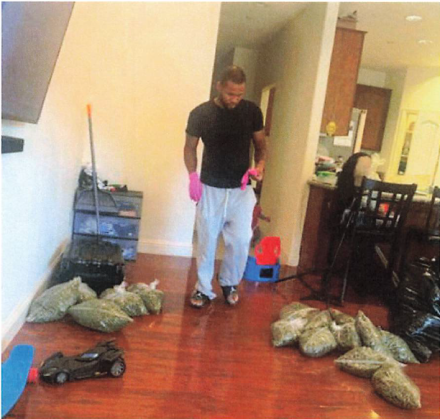
Before purchasing 5636 and 5371 West Acacia Avenue, Singletary and Coles lived in another home in Fresno, where Coles photographed Singletary packaging marijuana for shipment:
In addition to purchasing and reselling bulk marijuana, Singletary worked with Daniels to cultivate marijuana on a commercial scale at a warehouse on Van Ness Avenue in Fresno. In searching the warehouse, law enforcement discovered 424 marijuana plants at various stages of maturity in five commercial grow rooms with fans, air conditioning, and grow lights. Outside the warehouse itself, in the front entrance to the building and in an office off the front entrance, law enforcement discovered six plastic bags containing four pounds of processed marijuana buds; two digital scales; a money counter; a plastic dogfood container; luggage; shipping peanuts; and eBay packing tape. Footage from a surveillance system at the warehouse showed Daniels tending to the marijuana plants and bringing supplies into the warehouse with Singletary.
In searching David Singletary’s apartment in Cohoes, law enforcement discovered and seized, among other things, 29 vacuum-sealed packages of marijuana weighing approximately 19 kilograms and labeled, among other things, “GMO,” “Mimosa,” “Gary Payton,” “#45,” and “Gumbo 3A,” a dogfood container with ten clear knotted plastic bags each containing approximately one pound of marijuana, a clear plastic bag containing marijuana next to a scale on the kitchen counter, a gun box with 11 rounds of .40 caliber Winchester ammunition in a 12-round magazine, a money counter, a vacuum sealer, jewelry worth over $30,000, and $14,552 in cash.
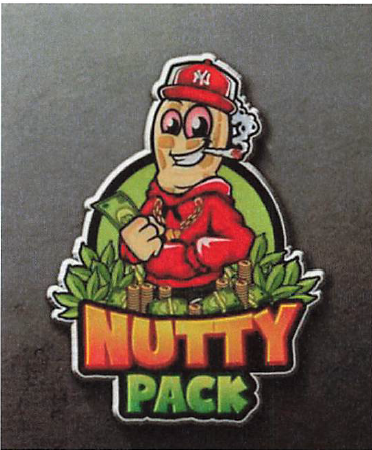
To promote the marijuana trafficking organization, Coles created an Instagram account in the name nutty_packz, and in searching David Singeltary’s apartment, law enforcement discovered marijuana packaging materials with the “Nutty Pack” emblem.
In searching Mumphrey’s home in Albany, which he shared with his wife, Latrice Mumphrey, law enforcement discovered a backpack containing two plastic bags of marijuana with “41 Cherries” and “Dulce De Leche” written on the side. A locked room in the basement contained a plastic dogfood container with “41 Cherries $3,600,” “Dulce De Leche $3,800,” and “12 Lows $700” written on the side and with eight bags of marijuana weighing approximately one pound apiece. The locked room also contained a suitcase with four firearms—a Ruger model AR-556 5.56x45mm caliber semiautomatic rifle, 5.56x45mm caliber semiautomatic rifle, Anderson model AM-15 5.56x45mm caliber semiautomatic rifle, and Taurus 9mm caliber pistol—and assorted ammunition.
Caldwell’s apartment in Albany contained marijuana, THC edibles, digital scales, boxes from Fast Pack & Ship, $15,941 in cash drug proceeds, and a .380 caliber handgun. Armstrong’s apartment in Rotterdam contained seven vacuum-sealed packages of marijuana weighing 10 pounds; two money counters; and $18,723 in cash. The apartment also contained a loaded .357 revolver, a loaded .22 caliber “ghost gun,” and 125 rounds of .357 ammunition.
The search warrants did not deter Singletary, David Singletary, and other members of the organization and they continued to traffic marijuana, including out of the “knock spot” at 2657th Avenue. In searching 2657th Avenue a second time on November 11, 2022, law enforcement discovered prepackaged marijuana, a loaded Taurus G2C 9mm handgun, and paperwork in David Singletary’s name.
After the search, Singletary and David Singletary moved the “knock spot” to an apartment next door at 2655 5th Avenue, Troy, New York, which was searched pursuant to warrant on January 4, 2023. A whiteboard offering marijuana for sale was outside the door to 2655 5th Avenue, which had a slot used to exchange marijuana for money. The same day, law enforcement executed a second search warrant at David Singletary’s apartment in Cohoes, which contained approximately 74 pounds of marijuana in vacuum-sealed packages.
The marijuana and THC trafficking generated millions of dollars in revenue, which Singletary and other members of the organization laundered through a variety of means. David Singletary routinely gave other members of the organization, including Clements and Kristle Walker, aka “Demii,” locked suitcases containing well over $150,000 in cash marijuana and THC proceeds. Walker and Clements then separately flew from Albany to Fresno, where they delivered the cash to Singletary and Coles. In July 2020, Walker attempted to board a flight from Albany to Fresno with a suitcase containing $179,710 in cash drug proceeds, which was seized by law enforcement. The cash belonged to Singletary, but in seeking return of the cash from the DEA, Walker falsely claimed ownership.
Federal law requires financial institutions to complete a currency transaction report for cash transactions over $10,000. At Singletary’s direction, Walker, Clements, Banks, Mumphrey, Latrice Mumphrey, and another member of the organization, Alyssa June White, purchased multiple cashier’s checks in amounts slightly below the reporting threshold for cash transactions of over $10,000, but amounting to over $10,000 in total, oftentimes at different banks and branches on the same day. The cashier’s checks were payable to Singletary; his company, DAS Empire, Inc.; his real estate law firm; a company from which he and Coles purchased real estate; and to a person from whom Singletary and DAS Empire purchased real estate.
Singletary, at times through DAS Empire, purchased and renovated several properties in the Capital Region with marijuana proceeds. He used the cashier’s purchased with cash marijuana proceeds to pay for the properties, and paid contractors renovating the properties with cash marijuana proceeds. In 2021, Singletary and Coles used $430,000 and $390,000 in marijuana proceeds to purchase 5363 and 5371 West Acacia, respectively. The purchase price was paid through, among other means, cashier’s checks purchased with marijuana proceeds.
To make the marijuana proceeds appear like legitimate business income, members of the organization deposited hundreds of thousands of dollars in cash marijuana proceeds into accounts held by Coles in the name of her company, M.M.M.C. Management, and into business accounts held by Fane, who was previously employed as a banker but fired for money laundering. At Singletary’s directions, members of the organization—including Walker, Clements, and Shuler—sent over $103,000 in money transfers purchased with cash marijuana proceeds in the Capital Region to Fane and others in and around Fresno.
Law enforcement forfeited a total of over $2.53 million in cash, vehicles, jewelry, real property, and other assets from Singletary and other members of the organization.
Singletary faces at least 10 years and up to life in prison on the two counts to which he pled guilty, conspiring to distribute marijuana and conspiring to commit money laundering; fines of up to $10.25 million; and a term of supervised release of between five years and life. His plea agreement with the government calls for a sentence of 10- to 20-years imprisonment. If the court rejects the plea agreement, Singletary will be permitted to withdraw his plea. A defendant’s sentence is imposed by a judge based on the particular statute the defendant is charged with violating, the U.S. Sentencing Guidelines and other factors.
In addition to Singletary, 24 other defendants have pled guilty. The following defendants pled guilty to the following charges and received the following sentences:
Defendant | Charge(s) | Sentence |
James Tyrell Daniels, aka “Red” and “Ghost,” age 42, of Fresno | Two counts: (i) conspiracy to manufacture, distribute, and possess with intent to distribute marijuana, and (ii) conspiracy to commit money laundering | 180 months imprisonment |
Lawrence Mumphrey, aka “L,” age 47, of Albany | Three counts: (i) conspiracy to manufacture, distribute, and possess with intent to distribute marijuana and THC, (ii) possession of firearms in furtherance of a drug trafficking crime, and (iii) conspiracy to commit money laundering | 156 months imprisonment |
Deandre Caldwell, aka “Dilli,” “Dillinger,” and “Dre,” age 34, of Albany | Two counts: (i) conspiracy to manufacture, distribute, and possess with intent to distribute marijuana and THC, and (ii) possession of a firearm in furtherance of a drug trafficking crime | 97 months imprisonment |
Tyquan Armstrong, aka “Moose,” age 47, of Rotterdam | Three counts: (i) conspiracy to distribute and possess with intent to distribute marijuana, (ii) possession with intent to distribute marijuana, and (iii) possession of firearms in furtherance of a drug trafficking crime | 90 months imprisonment |
Toqwanda Ketchmore, aka “Quannie,” age 32, of Troy | One count: conspiracy to manufacture, distribute, and possess with intent to distribute marijuana | 24 months imprisonment |
Earnest Flood, aka “Pop,” age 68, of Richmond, Virginia | Two counts: (i) conspiracy to manufacture, distribute, and possess with intent to distribute marijuana, and (ii) conspiracy to commit money laundering | Time served |
JuneAllyson Osman, aka “Juney,” age 61, of Troy | One count: conspiracy to manufacture, distribute, and possess with intent to distribute marijuana | Two years’ probation |
The following defendants pled guilty to the following charges, face the following sentences, and are awaiting sentencing:
Defendant | Charge(s) | Potential Sentence |
McKenzie Merrialice Coles, aka “Kenzie,” age 39, of Fresno | Two counts: (i) conspiracy to manufacture, distribute, and possess with intent to distribute marijuana and THC, and (ii) conspiracy to commit money laundering | At least 10 years and up to life imprisonment (if accepted by the court, the plea agreement calls for sentence of up to 20 years imprisonment) |
Nehemiah Fane, aka “Neil,” age 44, of Fresno | Two counts: (i) conspiracy to manufacture, distribute, and possess with intent to distribute marijuana, and (ii) conspiracy to commit money laundering | Maximum sentence of 40 years imprisonment |
Sammy Olague, age 39, of Fresno | One count: conspiracy to manufacture, distribute, and possess with intent to distribute marijuana | At least 5 years and up to 40 years imprisonment |
Ruby Ledesma, age 28, of Fresno | One count: conspiracy to manufacture, distribute, and possess with intent to distribute marijuana | Maximum sentence of 20 years imprisonment |
David Singletary, aka “DB,” age 40, of Cohoes | One count: conspiracy to manufacture, distribute, and possess with intent to distribute marijuana | At least 10 years and up to life imprisonment (if accepted by the court, plea agreement calls for sentence of at least 10 years and up to 18 years imprisonment) |
Isiah Ti-Quan Clements, aka “Zay,” age 39, of Troy | Two counts: (i) conspiracy to manufacture, distribute, and possess with intent to distribute marijuana and THC, and (ii) conspiracy to commit money laundering | At least 10 years and up to life imprisonment |
Latrice Mumphrey, age 45, of Albany | One count: conspiracy to commit money laundering | Maximum sentence of 20 years imprisonment |
Rosemary Coles, age 74, of Troy | One count: conspiracy to manufacture, distribute, and possess with intent to distribute marijuana and THC | At least 10 years and up to life imprisonment |
Kristle Waler, aka “Demii,” age 42, of Albany | Two counts: conspiracy to commit money laundering and false statements | Maximum sentence of 25 years imprisonment |
Niara Banks, aka “Nie,” age 34, of Troy | Two counts: (i) conspiracy to manufacture, distribute, and possess with intent to distribute marijuana and THC, and (ii) conspiracy to commit money laundering | Maximum sentence of 40 years imprisonment |
Jazell Shuler, age 38, of Troy | Two counts: (i) conspiracy to manufacture, distribute, and possess with intent to distribute marijuana, and (ii) conspiracy to commit money laundering | Maximum sentence of 40 years imprisonment |
Victor Turner, age 72, of Troy | One count: conspiracy to manufacture, distribute, and possess with intent to distribute marijuana | Maximum sentence of 20 years imprisonment |
LaFay Pearson, aka “Lala,” age 25, of Troy | One count: conspiracy to manufacture, distribute, and possess with intent to distribute marijuana | Maximum sentence of 20 years imprisonment |
Consanga Harris, aka “Sondy,” age 65, of Troy | One count: conspiracy to manufacture, distribute, and possess with intent to distribute marijuana | Maximum sentence of 20 years imprisonment |
Alyssa June White, age 33, of Troy | One count: conspiracy to commit money laundering | Maximum sentence of 20 years imprisonment |
Onisha Smith, age 43, of Brooklyn | Two counts: (i) conspiracy to manufacture, distribute, and possess with intent to distribute marijuana, and (ii) conspiracy to commit money laundering | Maximum sentence of 40 years imprisonment |
Lateek White, age 55, of Brooklyn | Two counts: (i) conspiracy to manufacture, distribute, and possess with intent to distribute marijuana, and (ii) conspiracy to commit money laundering | At least 10 years and up to life imprisonment |
The DEA, ATF, Troy Police Department, and HSI investigated the case, with critical support from U.S. Attorney’s Office Financial Investigator Justus Derx. Assistant U.S. Attorneys Cyrus P.W. Rieck, Dustin C. Segovia, and Nicholas Walter are prosecuting the case.
This case is part of the Homeland Security Task Force (HSTF) initiative established by Executive Order 14159, Protecting the American People Against Invasion. The HSTF is a whole-of-government partnership dedicated to eliminating criminal cartels, foreign gangs, transnational criminal organizations, and human smuggling and trafficking rings operating in the United States and abroad. Through historic interagency collaboration, the HSTF directs the full might of United States law enforcement towards identifying, investigating, and prosecuting the full spectrum of crimes committed by these organizations, which have long fueled violence and instability within our borders. In performing this work, the HSTF places special emphasis on investigating and prosecuting those engaged in child trafficking or other crimes involving children. The HSTF further utilizes all available tools to prosecute and remove the most violent criminal aliens from the United States.
