Wednesday, December 10, 2025

NYC Council Investigation Finds Rikers Visiting Process Marred by Long Wait Times, Arbitrary Denials, and Poor Communication


Ahead of an oversight hearing on visiting Rikers Island, the New York City Council released a report outlining the challenges New Yorkers face while visiting a loved one being held at the jail. The investigation found visiting Rikers to be an “all-day” event, hindered by poor communication and information for visitors, long waiting periods, arbitrary visit denials, and unhelpful interactions with Department of Correction (DOC) staff. Investigators also observed apparent failures to comply with the regulations governing the visiting process, including those set by the Board of Correction’s (BOC) Minimum Standards and DOC’s own internal Visit Procedures Directive. The Council’s findings corroborate the experiences of some New Yorkers who have described visiting loved ones on Rikers as an arduous, confusing, and frustrating process.

The report, entitled Still Waitingcan be found here.

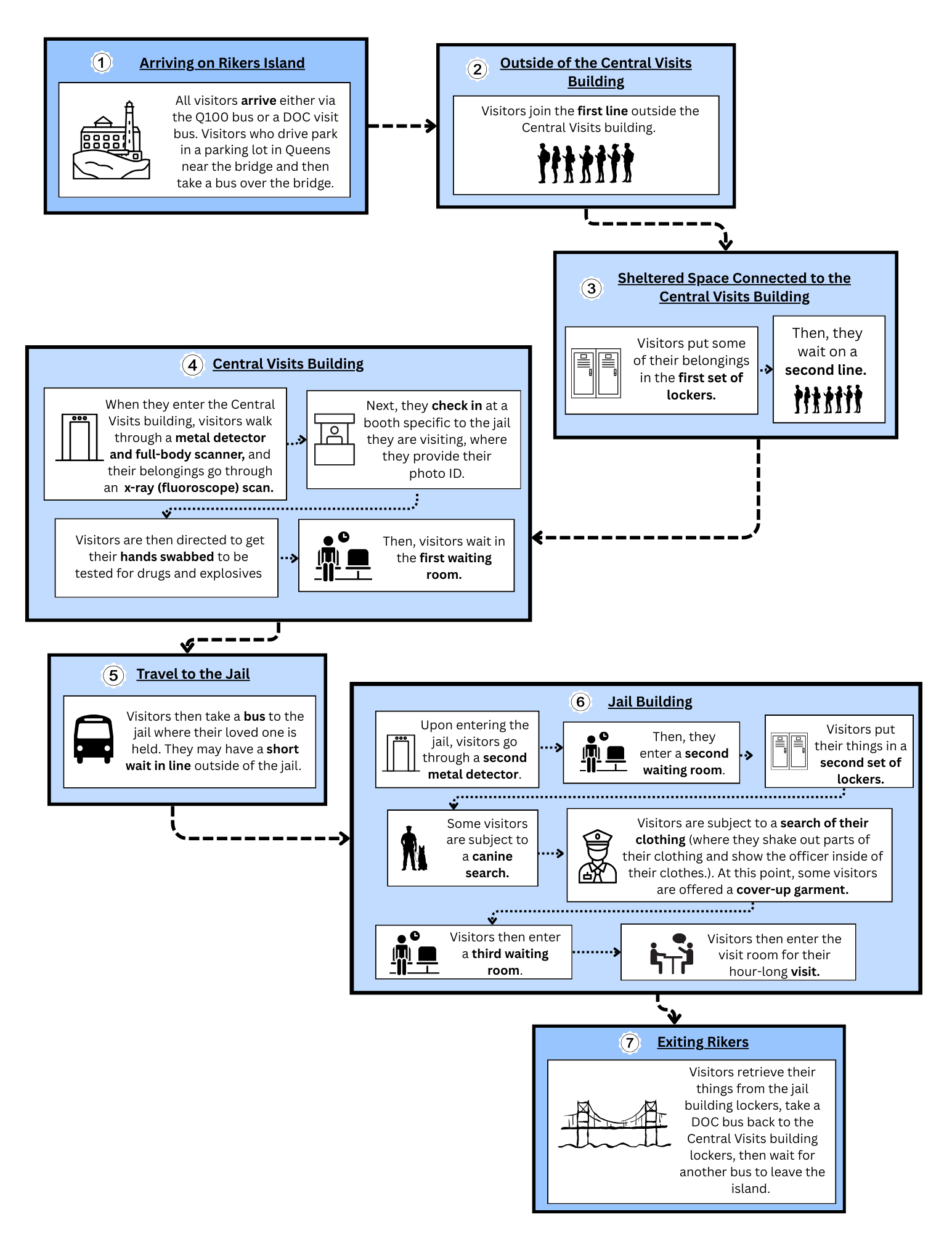
A flowchart depicting the process of a typical visit to Rikers, as observed by an investigator, can be viewed here.

“After a long trip to Rikers Island, New Yorkers who are visiting their loved ones too often encounter hurdles and barriers that make their experiences frustrating,” said Speaker Adrienne Adams. “Visiting someone at Rikers can be an emotional process, and the Department of Correction should take steps to ensure it is improved. Reforms to this process are paramount, and the difficulties described in this investigation only emphasize the need for the next mayoral administration to act with urgency in transitioning to a borough-based system that incorporates them. I thank the Council staff for their work and all those who participated in this important investigation.”

To understand and examine the visiting process at Rikers Island, the Council’s Oversight and Investigations Division reviewed previous Council hearings, held meetings with organizations familiar with Rikers visits, conducted interviews with individuals who had recently visited the jail system, visited a person detained on the Island, and attended an observation tour led by DOC.

The Council’s investigation revealed the following issues with the Rikers Island visiting process:

  1. Visiting Rikers Island can take several hours, not including travel to the Island.  In interviews, visitors shared that it had taken them over five hours for a one-hour visit. A Council investigator who took a recent trip arrived at 12:30 pm and left at approximately 7:00 pm. According to DOC’s own internal study, visitors spend an average of four-and-a-half hours on the Island for a visit.
  2. Visitors can wait for long periods of time outside the Benjamin Ward Visit Center without available seating or proactive information about access to restrooms or water fountains. Interviewees shared experiences of waiting outside the Visit Center for over an hour, and a Council investigator waited for an hour and 15 minutes (including 45 minutes after the start of visiting hours).
  3. DOC’s publicly available online information and posted signs on the Island fail to adequately prepare individuals for the visiting process. Interviewees described procedures that varied each time they visited, and feeling unprepared for the search process based on what they learned from others or could read online.
  4. Some visitors are denied visits due to their attire and are not offered cover-up garments, as required by DOC’s Visit Procedures Directive. A Council investigator’s visit and interviews revealed multiple instances of people being turned away at the Benjamin Ward Visit Center due to their clothing, without being offered a cover-up garment. DOC’s internal guidelines state that visitors should be offered cover-up garments, and those willing to wear one should be allowed to proceed through the process.
  5. Some visitors found DOC staff to be unhelpful when navigating the visiting process. Interviewees shared that they found officers to be inconsistent in their application of rules.

“This investigation makes clear what families have been saying for years: visiting a loved one on Rikers is an exhausting, confusing, and often dehumanizing ordeal,” said Council Member Gale Brewer, chair of the Committee on Oversight and Investigations. “This report underscores the need for a more consistent, humane, and efficient visiting process. We heard, for example, from visitors who waited more than an hour outside without access to seating, restrooms, or drinking water—conditions that fall short of the standards families should expect. Maintaining family connections is essential to the wellbeing of people in custody and to the stability of their loved ones, and the City has a responsibility to ensure those visits are safe, respectful, and accessible. I urge the Department of Correction to act swiftly on these findings.”

To ensure New Yorkers can see their loved ones with courtesy and respect, and without being denied access or experiencing long delays, the Council recommends the following improvements to the visiting process at Rikers:

  1. DOC should accelerate its assessment of the visiting process, publish its findings, and immediately take steps to enact improvements. Additionally, it should implement an online scheduling system as soon as possible.   
  2. DOC should add benches and clear signage directing visitors to the restrooms closest to the outdoor waiting area, in compliance with the Board of Correction’s Minimum Standards.
  3. In its Visit Procedures Directive, trainings, and a memo to all staff, DOC should clarify that dress code compliance should be assessed only once, at each jail, and that any visitor willing to wear a cover-up garment should not be denied visiting access.
  4. DOC should update its website and relocate on-site signs to ensure that visitors understand the rules and are properly prepared for visits. 
  5. DOC should evaluate its training for correction officers who work with visitors and assess the roles that non-uniformed employees or volunteers can play in family visits.

BRONX MAN SENTENCED TO 20 YEARS IN PRISON FOR RANDOM KILLING OF MAN AFTER KNIFING NEIGHBOR IN NOISE DISPUTE


Fatal Stabbing Victim Had Just Arrived at Building; Had No Part in Dispute 

Bronx District Attorney Darcel D. Clark today announced that a Bronx man was sentenced to 20 years in prison for first-degree Manslaughter for killing a man and wounding a neighbor during a stabbing attack stemming from a noise dispute. 

District Attorney Clark said, “This defendant turned a petty feud into deadly violence where he stabbed a neighbor and killed a man at random, who had nothing to do with the dispute. This crime is senseless, and the defendant will spend decades in prison for it.” 

District Attorney Clark said Jose Ortiz, 68, last of University Avenue, was sentenced to 20 years in prison and five years post release supervision for first-degree Manslaughter by Bronx Supreme Court Justice Joseph McCormack. He pleaded guilty to that charge on October 21, 2025. 

According to the investigation, on January 6, 2023, at approximately 8:57 p.m.., inside 1212 University Avenue, Ortiz stabbed a 39-year-old neighbor once in her torso with a kitchen knife. The defendant had been feuding and threatening her over loud noise. The defendant then stabbed Tyrone Quick, 58, three times in the torso. Quick had just arrived to visit a friend who lives in the building when the defendant inexplicably stabbed him in the hallway. Quick was taken to NYC Health + Hospitals Lincoln where he was pronounced dead.

District Attorney Clark thanked NYPD Detective Arelis Collazo of the Bronx Homicide Squad and Detective Jose Mercedes of the 44th Precinct Detective Squad for their work on the investigation. 

Governor Hochul Announces More Than $45 Million to Fund Supportive Housing Statewide

older couple standing on their porch

Boost in Funding Leads to the Empire State Supportive Housing Initiative Providing 200 Conditional Awards for More Than 8,300 Units Statewide

Housing to Serve Veterans, Individuals with Serious Mental Illness or Substance Use Disorder, Domestic Violence Survivors and Older Adults with Disabilities

Governor Kathy Hochul announced conditional awards of $45.9 million through the Empire State Supportive Housing Initiative or ‘ESSHI,’ a program that funds supportive services to help stably house New Yorkers experiencing homelessness. The program’s ninth round of funding resulted in 200 awards, which will fund services and operating expenses for up to 8,389 additional units of supportive housing to serve older adults, survivors of domestic and gender-based violence, veterans and chronically homeless families, and individuals with a mental illness or substance use disorder.

“Expanding supportive housing options for New Yorkers experiencing homelessness is a key step in helping vulnerable residents in their recovery,” Governor Hochul said. “Continued investments in the Empire State Supportive Housing Initiative allows more New Yorkers to get and maintain stable housing within communities of their choice. This effort will help individuals and families move from crisis to long-term stability and independence, pairing compassion with proven solutions that enable them to rebuild their lives with dignity.”

This year’s awards include 54 projects in New York City, 21 projects on Long Island, and 125 projects in locations north of the metropolitan area. These conditional awards –the most issued in a single round of the program –came after Governor Hochul secured a 53 percent increase in annual funding for the program as part of the FY26 Enacted Budget. View the awardees here.

With the increase, applicants were able to seek $34,000 annually per unit or qualifying individual in all five city boroughs, Suffolk, Nassau, Westchester, Rockland and Putnam counties — an increase of $9,000 over the previous rate. Likewise, developments in other areas of the state could apply for up to $31,000 annually per unit or qualifying individual, a $6,000 increase.

This initiative provides operating funding for supportive service providers serving homeless veterans and their families; survivors of domestic and gender-based violence; older adults who are disabled or frail; young adults with a history of incarceration, homelessness, or foster care; chronically homeless individuals and families; individuals with intellectual or developmental disabilities; individuals reentering the community from prison; and those living with HIV or AIDS, serious mental illness and/or substance use disorders.

Funding may be used for rental assistance and services to eligible target populations to ensure their housing stability. Permissible uses include rental subsidies and other occupancy costs; services or staff to identify and locate eligible individuals that need housing; primary and behavioral health services; employment and vocational training; educational assistance, parenting skills development and support; child care assistance counseling and crisis intervention; children’s services, including educational advocacy, support and counseling; and costs associated with services that help individuals and families remain stably housed.

ESSHI has provided funding to nearly 10,300 units of supportive housing since the program was established in 2016. The state Office of Mental Health serves as the lead procurement agency for the funding, which is dispersed by an interagency workgroup of eight state agencies serving vulnerable New Yorkers.

Awards are conditional and are contingent on a project securing capital funding for new construction, the adaptive reuse of non-residential property, or the rehabilitation of unregulated residential property to create integrated affordable supportive housing.

Research has shown that permanent supportive housing reduces the demand for shelters, hospital beds, emergency rooms, prisons, and jails, in addition to having a positive effect on employment, school attendance, and mental and physical wellbeing. Supportive housing projects can also positively impact neighborhoods through new construction or by rehabilitating existing buildings.

Bronx River Art Center (BRAC) - A home for creativity, community, and opportunity here in the Bronx.


Dear Friends of BRAC, 


As 2025 comes to a close, I’ve been reflecting on what an extraordinary and deeply meaningful six months it has been since I joined Bronx River Art Center as Executive Director. Every day, I’m reminded that BRAC is more than an arts center, it’s a home for creativity, community, and opportunity here in the Bronx.


This year, we saw remarkable growth and resilience:


  • Growing Participation: This year, more Bronx residents than ever have joined us for classes, exhibitions, festivals, and community events -nearly twice as many as last year- serving almost 5,000 people.. Every student, family, and visitor adds to the vibrancy and energy of BRAC.


  • A Community Gathering Place: BRAC has become a welcoming hub for the Bronx, offering free space to local civic groups and affordable space to other organizations. Our doors are open not just for art, but for connection, conversation, and collaboration across the community.
    
  • Our MSCreate program offers free after-school arts training to middle school students, helping them build portfolios and confidence for high school admissions.
    
  • Our Teen Project Studio guides young adults toward creative careers through mentorship and hands-on design, digital, and environmental arts projects.
    
  • Our Freshwater Fridays brings students and families together to learn about the Bronx River through environmental art and science.
    
  • Our Bronx River Sounds Festival and year-round exhibitions brought music, performance, and visual art to our community in new and inspiring ways.

We’ve also seen BRAC through a leadership transition, strengthened our team, and expanded partnerships with schools and community organizations across the borough — all while navigating the lingering impacts of reduced government funding and rising operational costs.


Yet, even as BRAC continues to grow, we face urgent challenges. Our boiler and elevator need repairs to ensure our facility remains safe and accessible. And our small but dedicated staff needs reinforcement to sustain our programs, engage more youth, and manage the high demand for affordable arts education.


That’s why we’re launching our 2025 Year-End Campaign to raise $25,000 by December 31st to:


  • Repair and maintain critical building infrastructure, including our elevator and boiler
    
  • Support, retain and expand our teaching artists, core staff and programming
    
  • Keep our after-school and weekend arts programs free or low-cost for Bronx families
    

Your contribution — whether $25, $250, or $2,500 — directly supports young artists finding their voices, teens building creative futures, and families discovering the joy of art close to home.


This holiday season, I invite you to help keep BRAC strong for the thousands of Bronx residents who rely on our programs.


Donate online here: https://givebutter.com/supportbrac

Or Mail a Check made out to Bronx River Art Center PO Box 5002, Bronx, NY 10460


Your generosity ensures that creativity, opportunity, and hope continue to flourish in our community.


With heartfelt thanks and warm wishes for a beautiful holiday season!


Akia Squitieri, 
Executive Director
Bronx River Art Center

Van Cortlandt Park Alliance - What’s your favorite place in Van Cortlandt Park?


At Van Cortlandt Park Alliance, we have a small but mighty team. Like you, each of our staff members has a deep connection to the park. Their passion drives everything we do—from restoring natural areas to educating youth to celebrating this incredible green space.

Over the next week, we’ll be sharing the places in Van Cortlandt Park that inspire our staff most and why they love them. We hope these stories encourage you to revisit your favorite spot—or discover a new one.

Follow along on Instagram or Facebook this month to see their favorite places!

Today, our Trail Stewardship Coordinator, Leslie Garcia, shares her favorite spot in Van Cortlandt Park:  

“Tucked along the Old Croton Aqueduct trail near the historic Old Weir, this stretch of forested area is more than just a scenic passthrough; it's a living showcase of collaborative stewardship, hands on conservation, and ongoing problem-solving in Van Cortlandt Park. As one of the park’s most flood-prone corridors, this area has faced persistent management challenges due to a chronically clogged and undersized drain beneath the weir. Repeated flood events have eroded the trail to the point where sections of the original aqueduct stones are now exposed.

For me as Trail Stewardship Coordinator with Van Cortlandt Park Alliance, this spot represents the heart of what partnership-driven restoration can accomplish. Beginning early this spring, I’ve worked alongside an incredible team of collaborators including the Natural Areas Conservancy, Student Conservation Association, the Jolly Rovers, community volunteers and VCPA’s seasonal trail crew, on a multi-phase retaining wall and drainage improvement project. Of course, we do this all in support of and with the guidance of NYC Parks! 

This section of the Old Croton Aqueduct trail isn’t just a favorite place. It's a testament to how committed hands, shared expertise, and long-term stewardship can revive a landscape shaped by both history and natural forces.”

Please consider supporting our staff by making a gift today to champion their work, and the park you love!


Our Contact Information
Van Cortlandt Park Alliance
80 Van Cortlandt Park South, Ste. E1
Bronx, NY 10463
718-601-1460
http://vancortlandt.org

Justice Department Announces Actions to Combat Two Russian State-Sponsored Cyber Criminal Hacking Groups


Ukrainian National Indicted and Rewards Announced for Co-Conspirators Relating to Destructive Cyberattacks Worldwide

The Justice Department announced two indictments in the Central District of California charging Ukrainian national Victoria Eduardovna Dubranova, 33, also known as Vika, Tory, and SovaSonya, for her role in conducting cyberattacks and computer intrusions against critical infrastructure and other victims around the world, in support of Russia’s geopolitical interests. Dubranova was extradited to the United States earlier this year on an indictment charging her for her actions supporting CyberArmyofRussia_Reborn (CARR)Dubranova was arraigned on a second indictment charging her for her actions supporting NoName057(16) (NoName). Dubranova pleaded not guilty in both cases and is scheduled to begin trial in the NoName matter on Feb. 3, 2026, and in the CARR matter on April 7, 2026. 

As described in the indictments, the Russian government backed CARR and NoName by providing, among other things, financial support. CARR used this financial support to access various cybercriminal services, including subscriptions to distributed denial of service-for-hire services. NoName was a state-sanctioned project administered in part by an information technology organization established by order of the President of Russia in October 2018 that developed, along with other co-conspirators, NoName’s proprietary distributed denial of service (DDoS) program. 

“These actions demonstrate the Department’s commitment to disrupting malicious Russian cyber activity — whether conducted directly by state actors or their criminal proxies — aimed at furthering Russia’s geopolitical interests,” said Assistant Attorney General for National Security John A. Eisenberg. “We remain steadfast in defending essential services, including food and water systems Americans rely on each day, and holding accountable those who seek to undermine them.” 

“Politically motivated hacktivist groups, whether state-sponsored like CARR or state-sanctioned like NoName, pose a serious threat to our national security, particularly when foreign intelligence services use civilians to obfuscate their malicious cyber activity targeting American critical infrastructure as well as attacking proponents of NATO and U.S. interests abroad,” said First Assistant U.S. Attorney Bill Essayli for the Central District of California. “The charges announced today demonstrate our commitment to eradicating global threats to cybersecurity and pursuing malicious cyber actors working on behalf of adversarial foreign interests.”

“When pro-Russia hacktivist groups target our infrastructure, the FBI will use all available tools to expose their activity and hold them accountable,” said Assistant Director Brett Leatherman of the FBI Cyber Division. “Today’s announcement demonstrates the FBI’s commitment to disrupt Russian state-sponsored cyber threats, including reckless criminal groups supported by the GRU. The FBI doesn’t just track cyber adversaries – we work with global partners to bring them to justice.”

“The defendant’s illegal actions to tamper with the nation’s public water systems put communities and the nation’s drinking water resources at risk,” said EPA Acting Assistant Administrator Craig Pritzlaff. “These criminal charges serve as an unequivocal warning to malicious cyber actors in the U.S. and abroad: EPA’s Criminal Investigation Division and our law enforcement partners will not tolerate threats to our nation’s water infrastructure and will pursue justice against those who endanger the American public. EPA is unwavering in its commitment to clean, safe water for all Americans.”

Cyber Army of Russia Reborn

According to the indictment, CARR, also known as Z-Pentest, was founded, funded, and directed by the Main Directorate of the General Staff of the Armed Forces of the Russian Federation (GRU). CARR claimed credit for hundreds of cyberattacks against victims worldwide, including attacks against critical infrastructure in the United States, in support of Russia’s geopolitical interests. CARR regularly posted on Telegram claiming credit for its attacks and published photos and videos depicting its attacks. CARR primarily hacked industrial control facilities and conducted DDoS attacks. CARR’s victims included public drinking water systems across several states in the U.S., resulting in damage to controls and the spilling of hundreds of thousands of gallons of drinking water. CARR also attacked a meat processing facility in Los Angeles in November 2024, spoiling thousands of pounds of meat and triggering an ammonia leak in the facility. CARR has attacked U.S. election infrastructure during U.S. elections, and websites for U.S. nuclear regulatory entities, among other sensitive targets.

An individual operating as “Cyber_1ce_Killer,” a moniker associated with at least one GRU officer instructed CARR leadership on what kinds of victims CARR should target, and his organization financed CARR’s access to various cybercriminal services, including subscriptions to DDoS-for-hire services. At times, CARR had more than 100 members, including juveniles, and more than 75,000 followers on Telegram.

The CARR indictment charges Dubranova with one count of conspiracy to damage protected computers and tamper with public water systems, one count of damaging protected computers, one count of access device fraud, and one count of aggravated identity theft. If convicted of these charges, Dubranova would face a statutory maximum penalty of 27 years in federal prison.

NoName057(16)

NoName was covert project whose membership included multiple employees of The Center for the Study and Network Monitoring of the Youth Environment (CISM), among other cyber actors. CISM was an information technology organization established by order of the President of Russia in October 2018 that purported to, among other things, monitor the safety of the internet for Russian youth.

According to the indictment, NoName claimed credit for hundreds of cyberattacks against victims worldwide in support of Russia’s geopolitical interests. NoName regularly posted on Telegram claiming credit for its attacks and published proof of victim websites being taken offline. The group primarily conducted DDoS cyberattacks using their own proprietary DDoS tool, DDoSia, which relied on network infrastructure around the world created by employees of CISM.

NoName’s victims included government agencies, financial institutions, and critical infrastructure, such as public railways and ports. NoName recruited volunteers from around the world to download DDoSia and used their computers to launch DDoS attacks on the victims that NoName leaders selected. NoName also published a daily leaderboard of volunteers who launched the most DDoS attacks on its Telegram channel and paid top-ranking volunteers in cryptocurrency for their attacks.

The NoName indictment charges Dubranova with one count of conspiracy to damage protected computers. If convicted of this charge, Dubranova would face a statutory maximum penalty of five years in federal prison.

Concurrent with these actions, the U.S. Department of State has offered potential rewards for up to $2 million  for information on individuals associated with CARR and up to $10 million for information on individuals associated with NoName. Additionally, today the FBI, CISA, NSA, DOE, EPA, and DC3 issued a Joint Cybersecurity Advisory assessing that pro-Russia hacktivist groups, like CARR and NoName, target minimally secured, internet-facing virtual network computing connections to infiltrate (or gain access to) operational technology control devices within critical infrastructure systems to execute attacks against critical infrastructure, resulting in varying degrees of impact, including physical damage.

On July 19, 2024, U.S. Department of Treasury’s Office of Foreign Assets Control (OFAC) announced sanctions targeting two CARR members, Yuliya Vladimirovna Pankratova and Denis Olegovich Degtyarenko, for their roles in cyber operations against U.S. critical infrastructure. These two individuals were the group’s leader and a primary hacker, respectively.

The FBI Los Angeles Field Office investigated the CARR and NoName cases as part of FBI’s Operation Red Circus, an ongoing operation to disrupt Russian state-sponsored cyberthreats to U.S. critical infrastructure and interests abroad.

Assistant U.S. Attorneys Angela Makabali and Alexander Gorin for the Central District of California and Trial Attorney Greg Nicosia of the National Security Division’s National Security Cyber Section are prosecuting these cases. Assistant U.S. Attorney James E. Dochterman for the Central District of California is handling the forfeiture cases. The Justice Department’s Office of International Affairs provided significant assistance for both investigations.

An indictment is merely an allegation. All defendants are presumed innocent until proven guilty beyond a reasonable doubt in a court of law.

New York City Faces Record High Youth Mental Health Crisis: Comptroller Lander’s Report


Comptroller Lander’s report uncovers critical staffing shortages, fragmented care, and a lack of transparency in New York City Public Schools 

Under resourced New York City Public Schools are facing a growing youth mental health crisis, according to a new report from New York City Comptroller Brad Lander. With close to 40% of New York City high school students reporting persistent sadness or hopelessness, Comptroller Lander’s report finds that fragmented funding, severe workforce shortages, and uneven access to care prevent the New York City Public Schools from adequately addressing this public health emergency. 

“After decades of underinvestment in our schools, a global pandemic, and now unprecedented social upheaval, our city’s young people are left facing the direct impact all at once,” said Comptroller Brad Lander. “A city that invests in young people’s mental health is a city securing its future.” 

The report, leveraging data analysis and stakeholder interviews, reveals that New York Public School students are 21 times more likely to seek mental health support at school than at a community clinic. Yet the system is failing to meet this demand: over 70% of schools do not meet national standards for social worker staffing, and 53% fall short for guidance counselors. Moreover, for many students of color, an estimated 88,000 English Language Learners students (ELLs) attend schools with no bilingual mental health staff member at all. 

Key Findings from the Report: 

  • Severe Staffing Shortfalls: To meet national standards and address the growing need, the DOE would need to hire approximately 2,137 additional social workers and 1,220 guidance counselors, at an estimated annual cost of $402–$426 million. 
  • Inequitable Access: School-Based Health Centers (SBHCs)—the preferred, discreet model identified by students and administrators—are chronically underfunded. Fully funding existing SBHCs and expanding them to all large high schools would require an additional $40.3 million annually. 
  • Systemic Fragmentation: The DOE has not centralized or digitized its records to track mental health referrals or services; instead, the DOE relies on paper notes and spreadsheets which leaves students at risk. 
  • Financial Opacity: To date, there is no unified tracking on school-based mental health, as funding is buried in broad budget lines.  
  • Understaffed, Underserved: 53% of NYC schools do not meet minimum guidance counselor ratios. The City is roughly 18% below the national standard for school psychologists (1:250), with an average of one psychologist for every 574 students. 

A Roadmap for Action: Core Recommendations 

The report outlines a multi-pronged strategy to build a sustainable, equitable mental health infrastructure: 

  • Integrate Mental Health into School Framework: DOE should Implement universal mental health screenings and embed Social-Emotional Learning (SEL) into daily advisory periods. 
  • Create a Plan to Meet Staffing Standards: City Hall to establish a cross-agency working group to develop a phased, fiscally responsible hiring roadmap for mental health professionals. 
  • Stabilize and Expand School-Based Health Centers and Mental Health Continuum: The DOE should commit funding to fully support existing SBHCs and expand to 75 additional large high schools with a clear process for expansion that prioritizes high-needs schools. Baseline finding for the City’s Mental Health Continuum, that supports many of the City’s School Based Mental Health Centers and additional mental health supports. 
  • Diversify and Grow the Workforce:  While State certification rules prevent the DOE from directly employing certain licensed mental health professionals, the agency has, in principle, far greater flexibility to bring these providers into schools through its contracts and vendor partnerships. DOE should expand and update upcoming contracts with community-based organizations to include a broader range of licensed and non-clinical mental health professionals excluded from current DOE hiring structures. Build career pipelines throughout high school and mental health related graduate programs. 
  • Implement a Digital Case Management System: The DOE should expedite the rollout of a secure, system-wide platform to track referrals, services, and outcomes. 
  • Ensure Transparent Spending: City Hall should develop a public reporting framework to track all mental health-related spending across the DOE. 

“We are failing to connect tens of thousands of students to the care they need, with potentially devastating consequences,” Comptroller Lander continued. “This is a solvable crisis, but it requires treating student mental health as a real policy priority. Every dollar invested in early intervention saves significantly more in the long term. We have solutions that work; what we lack is the coordinated will and investment to bring them to every student. Our children’s well-being and academic success depend on it.”